Reviews Coming Soon
Tuesday, July 18, 2017
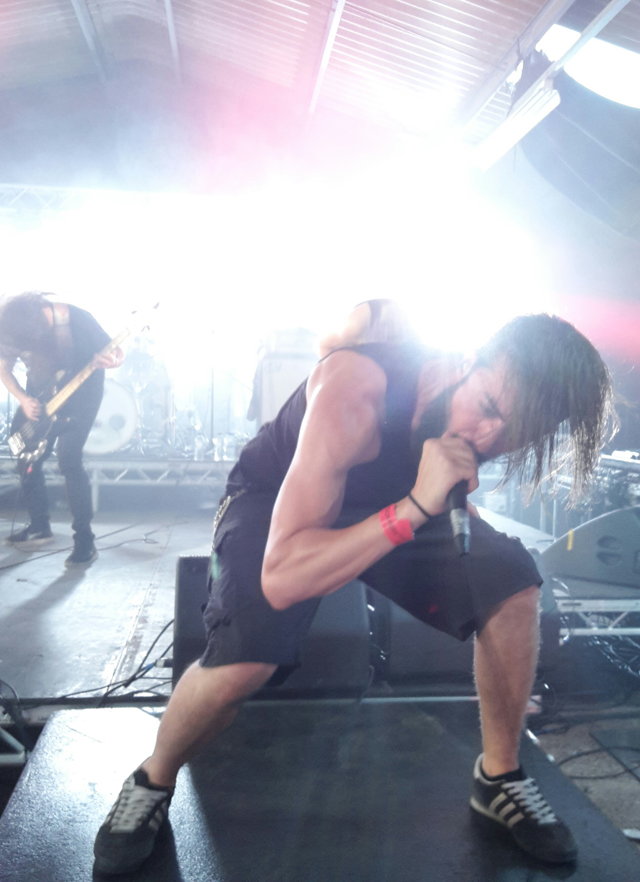
Live Review: UK Tech-Fest, Newark Showground, Saturday 8th July 2017
Johnski’s mission should he choose to accept it? Absorbing 7 hours of instrumental technicality; music sans vocals.
So what did he learn? Well, it imbued him with a new found appreciation of the drummer’s art. From the maniacally complex blur of sticks and feet on skin to the vast swathes of silence, deftness of touch and light glances of cymbal. The variety of percussion required when creating music devoid of the human voice was vast. And whilst there appeared to be a decreasing use of bass guitar there was conversely the increasing use of ambient recordings in this art form. It was also noticeable just how often certain instruments have risen to the fore in technical music over the years – see reviews for examples.
So… back to the present tense and the first band on the bill for the day. Altostratus, a quartet named after a high cloud formation, play a groovy, light, yet complex, form of technical rock with a soft, elegiac flow. Their bassist looms large in everything they do, setting a strong rhythm, striding wildly from step to step across the stage. The twin guitarists create some beautiful finger shapes, and aren’t afraid of palm-muting or riffing. They switch guitars regularly and at one point a small black box Strandberg guitar, no bigger than a banjo, is produced. Ultimately, they do thrash out one too many bar chords for my liking and just don’t work over their cute riffs for long enough to fully immerse yourself in their songs. Having said that, there are some wonderful flurries of colour to be found in key track “Hidden In A Cloud”. (JS)
Crushing bass lines, a growly vocalist, who looked as if he wanted to cause harm, and all-round heaviness were the meat and veg from Harbinger. Actually, not so much veg. The vocalist made the common mistake of mumbling song titles but I gathered beforehand from the guy on the merch stand that most of this set came from the recently released EP “Human Dust”. I loved the hard-hitting riffs, the heavy bass line and the technical hardcore energy. One vocalist briefly became two – that’s one way of getting over the noise. This was aggressive layered technical metal without ever being too clever about it. Structures held together well even in the onslaught of such brutal chaos. Harbinger had great presence too. The vocalist had grace and humour. Heads banged, faces twisted and the bassist in the multi-coloured shirt, which made me think that a blackcurrant-consuming bird had deposited its stuff, joyously lived and breathed every moment. The band rose to the occasion. This was everything you would hope for from a live performance. (AD)
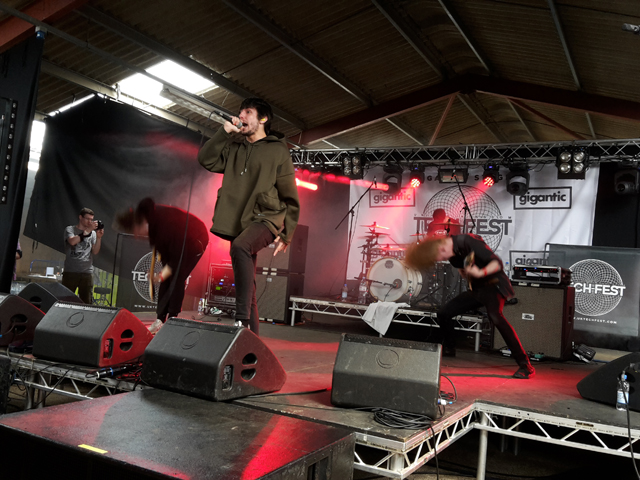
A thin and pale-looking man in a green hooded wind cheater growled and screamed like a cat, as the instrumentalists around him pumped out irregular, djenty dirt. It stopped. “We are Nycosia”, he announced politely in a refined accent. Thanks. Now back to screams and dissonance of a highly disturbing and entertaining nature. Green Man’s face turned redder as he rapped venom into his mic for our benefit. Oodles and oodles of energy and aggression poured out of every crevice. Chunk – clunk – chunk, they’re angry. Everyone’s angry but happy. Sampled distorted crawliness led to a further mentally deranged breakneck fury fest, breaking down somewhere along the line into mind-altering doom. Oompah-oompah. The experimentation knew no bounds. It was brutal. It turned punishingly dark out there. Somehow we finished up in a cosmic void. This was fine fare for 2 o’clock on a Saturday afternoon. Immaculately presented, this was warped music for creative minds. Well done. Does Nycosia come on prescription? Luckily Green Man didn’t burst a blood vessel. The man needs a nice cup of tea after all that. (AD)
With more Strandberg’s on display for Wisconsin duo (a trio for the tour) The Fine Constant, it certainly becomes apparent that it is this year’s instrument de rigeur. Adored by axe technicians for its lightness and adaptability, the guitarists here show just how adaptable they can be. Lead guitarist, Sarah Longfield, drives the twinkling top-end whereas the tour backing guitarist adds bassier textures with bar chords and riffs. Sarah’s finger shapes, speed and lightness of touch is astonishing and mesmeric in equal measure. She rarely visits the base of the guitar neck to strum, employing the finger-tapping method to great effect. Their music brings a strong arpeggio game, but sadly the performance and finished product feel vacant, like it’s missing something. Perhaps it’s the size of the stage, the loss of momentum between songs or the lack of engagement with the crowd, but for some reason the absence of vocal seems particular noticeable. (JS)
With less ambiguous arpeggios and a groovier soul, The Parallax Method, are three guys who obviously love what they do. Throughout the set, they’re exchanging smiles, teasing each other with new tricks and change-ups. Ben Edis on bass spends the whole set bobbing his head in time with his own rhythm, rocking gently forwards and backwards, and sandal-wearing guitarist Danny Beardsley isn’t far behind him. The drummer plays intense, rapid rhythms and displays huge technical skills. This band know their way around their instruments but they still fall short on variety. There is much similarity between the songs but what is there is solid. Pulling out of the groove to develop the layers would help lift what good foundations they have laid. (JS)
My immediate impression of seeing Exist Immortal on stage was that they are a well-drilled band. Co-ordinated head-banging, movement and horns gave a slick appearance. Musically, deep waves flowed through a heavily progressive sound. The singer mixed growls and clean vocals very well. Normally I pick up bands for having insufficient presence, but at the start I felt there was too much. All the gesturing and posturing were those of self-appointed, posing rock gods. The music itself had power and energy. There was plenty of energy in fact and moreover plenty of hair on stage to swing. And it flowed – the songs were strong, the riffs were solid and dark, and the clean vocals added impact to this melodic heaviness. The singer looked like Damian Wilson and when he spoke sounded like him. The vocal delivery was more akin to Scar Symmetry. Inciting the crowd to chant “we are non believers” was a bit daft, I thought, and the bassist became unhooked in his enthusiasm, but the stage performance settled down after initially being distracting. The crowd bounced, even the guy with the bandaged foot. I’d quite like to listen to the recorded version of these songs without the distraction of seeing these guys prancing about and without the wall of sound. I suspect they would be rather good. Well, on a hunch I bought Exist Immortal’s album “Breathe” (2016) so I guess I’ll find that out soon. (AD)
Maxi Curnow, producer, composer, fire-fighter and Tech-Fest favourite, always goes down well with the crowd and here it is no surprise to see just how well his unique brand of jazzy, progressive, groove-laden tech metal is received – he takes the adoration with a series of appreciative nods, thank yous and humble blushes. Further comment would be somewhat unfair seeing as, due to rumbling bellies, neither our intrepid reviewers got to witness his full set. (JS)
Dutch quartet, Exivious, featuring current and ex-members of Dodecahedron and Cynic, greeted us with the news that they were (like a couple of others) on their farewell tour. They certainly gave us a big echoing sound to absorb. Imagine yourself being in the belly of a whale, hearing the groaning of the ocean beyond its ribcage. Such was the impact of combining a multitude of effects pedals with an impressive and aggressive drummer. Some songs breathed fire, some froze in our veins. They certainly maintained a steely resolve throughout, their respective members smiling with each twist of the story conjured. Indeed, our lead guitarist seemed lost in his own little world; eyes covered by shades, ears covered by headphones, rocking and rolling his way to oblivion. With so little crowd interaction, the “all-male futuristic instrumental hit machine” left us a little bemused but certainly with something to mull over. (JS)
“Platfarm faave” was the sole contribution to humanity that I ever heard from the man on the gate at Hull Paragon station. It didn’t matter where you were going. It was always platfarm faave. The man was a legend. Not yet legends but also from Hull are The Colour Line. They certainly took the dull out of Hull. The band looked excited. Soon they were up and at us. Mayhem followed. The vocalist, guitarist and bassist ran around and jumped on things amid punk hardcore energy and noise. They wouldn’t stand still for Johnski’s photo, the buggers. The vocalist was in the moshpit and we were on the first song. I found myself confronted by the burly bassist. No time for chit-chat. It was carnage but let’s not forget they can play. Here was technical hardcore with extra ferocity but as a guaranteed bonus the rhythms were infectious and providing fuel. “I am extremely unfit”, announced the vocalist who set about disproving the point. Smash-bang-wallop: the noise was total, there was much kicking and screaming and hammering, and the songs were great. The vocalist reflected: “In our wildest dreams did we not imagine that so many people …. would be leaving the room at once”. The tension built up as “R.E.D” started with a tribal technical rhythm. The angry joy was abundant. Did I hear a little jazz insertion? Where to look? The singer was on the amp and in the crowd again. The guitarist jumped on the security guy’s shoulders. Leads got tied up. The guitarist stood on the drum kit. Heavy, heavy, thunder and chaos. The set was cut off at 4.30 but with a bit of persuasion all round, The Colour Line were back to play “Colonel Sanders Flying Machine” to delight us with more technical anarchy. And inevitably, orchestrated by the vocalist, it finished up with a mass pile-up of bodies in the middle of the floor. The guitarist confirmed to me later that the band is breaking up and they have just one more gig to play in their home city. That’ll be a riot. Newark 0, Hull 4. (AD)
It’s hard to believe that The Algorithm are a duo, albeit one with a neat symbiotic relationship, considering the level of noise that emerges from their respective tools. Whereas Jean Ferry batters various drums and cymbals with sticks, Rémi Gallego sends loop after loop skittering into the ether before backing it up all up with a chaotic set of tones and rhythmic patterns powered by synth and guitar. The effect is to place their music somewhere between dance and metal. It’s a destructive sound, bordering on drum and bass, prog and at times breakbeat. Occasionally, you’ll seriously wonder which instrument is playing percussion. Was that backbeat from the synth, the double-kick, or the guitar? The crowd are lapping it up and between songs shout “Oui! Oui!”, baying for the Gallic master-class to play on. With the drum-kit up near the front of the stage, it’s a pretty destructive sound. The force of the double-kick and the way it mashes with the guitar chugs (with the whole meshing to form what sounds like dog barks) bully your chest and lift you off your feet. They hammer through crowd favourites like “Brute Force” and “Deadlock” before letting their collective imaginations fly for “Floating Point” and “Machine”. Then, just for shits and giggles they attempt to scramble your psyche by tripping the light fantastic with “Access Granted” and that subversive section of ragga/dubstep. The circle pit slows from a mad-dash to a slow-motion jive and the party and, indeed, the day ramps up a level. (JS)
Compared to previous acts, the Gigantic stage hall was fairly empty, maybe on account of the fact that people wanted their dinner. Around 50 spectators gathered to watch Red Seas Fire. This band hadn’t set the world ablaze on the last occasion I saw them. Here again there was plenty of honest energy but what I heard seemed uncoordinated. The angry tech rhythm wasn’t especially angry. The clean vocals weren’t strong and were a bit whiny. The strength lay in the drums department. Here and there Red Seas Fire came out of their shell with all guns blazing and showed they were capable of rip-roaring, bouncing metal. Judging by the number of members of other bands in the audience, maybe Red Seas Fire could be seen as a band’s band. (AD)
My expectations were high for Uneven Structure. Other than segments, I hadn’t heard their latest album “Partition” (2017) before today, but their previous works and live performances told me I was going to witness something mesmerising, dark and epic. Normally silky smooth and lofty in spite or even because of the weight from the four instrumentalists, I found this set hard work as it never seemed to get going. Matthieu’s vocals haunt and float when he’s not growling, but here it was difficult for him to generate atmosphere above the wall of djenty noise. “Partition” evidently doesn’t engender fog. It does require immense sounds. Another guitarist appeared. The young drummer looked like was having the time of his life. The other instrumentalists exuded a mixture of gravitas and pleasure. This was too lyric-heavy. More atmosphere please. There was atmosphere and Uneven Structure built it up as is their wont, but this was no pressure cooker with ever increasing tension. “Partition” would seem to be a series of distinct experiences. I get that Uneven Structure would want to expand their sound, but it was as if Matthieu were making his lengthy vocal appeal through thick clouds. At one point the wall of sound accompanied a slow, lingering and emotional ballad. I’d not heard a djent ballad before. The power can be overwhelming. The complexity is haunting. It’s about tones of darkness. There’s little light here. It was impressive in flashes, but the sound mix and the lack of obvious logic in the musical story-telling wasn’t making this easy. Matthieu almost fell off the drum platform as he initiated a series of pungent explosions. This could be very heavy. The fog then appeared. The sad looking guitarist played a melancholic tune. The other two guitarists enigmatically faced the back of the stage as Matthieu sang and the drummer injected sophistication. The song built up and everyone was in the game again. The wall of sound and growls were as ever immense. The guitarist in front of me fell to the floor in exhaustion or emotion, not sure which. Fiery death metal followed. Matthieu incited the crowd. The crowd responded. The band lined up and subjected us to a wall of djent and enormity. Matthieu roared and floated dreamily above the deathly heaven. This was Uneven Structure of old – the start of Februus (2011) in fact. Finally, I felt uplifted. And it built up to a crescendo of power, ferocity and intensity. It was evident that the band felt it too. It was a magnificent ending but to this point I struggled with this set. The depth and complexity are unquestioned. Maybe if I’d known what “Partition” is about, it might have helped, but I felt that there was a lack of continuity coming from these heavy progressive tableaux. Matthieu struggled to rise above the intensity of sounds, and his message was lost for me. Yet in spite of my reservations and to some extent disappointment, this was still an impressive experience. (AD)
As I stood and watched the lads from Andorran death metal outfit Persefone warm up, it became apparent that something wasn’t quite right. Little clue did I have that I and the eventual audience were to witness something truly special. Just before they started playing in earnest, frontman Mark Martins Pia made a solemn announcement to the audience that their band-mate Miguel had been hospitalised before the show. However, they had agreed not to let the fans down and plough on despite no longer having a keyboard player, or backing vocalist, and as they had discovered, no compatible samples or effects (somewhat key to a complete performance). It later transpired, that they were also about to experience the full gamut of technical issues from loose ear monitors to PA system failure. However, true to their word, through shrugged shoulders, bit lips, hung heads and apologetic grimaces they “had fun” with it and put on an absolute stonker of a show. Having been accused previously of weak performances and crowd interaction, they tore into their set and constantly offered feedback, praising the crowd who reacted with nothing but joyous abandon and rapturous applause. Pia basically gave us a lesson in how important the bond between band and audience can be. He leapt from front to back of the stage; prowled from left to right. He climbed risers, speaker stacks, crowd-surfed and balanced precariously on the barriers with multiple arms supporting him. He even conducted the circle pit from inside it! The man was a tour de force. Yes, there were whole sections missing but where possible Pia sung (a surprise to even him) the clean backing vocals whilst the crowd hummed the missing samples. At one point this heroic frontman even ran to the front of the crowd to ram his mic under the lips of an intro-whistling crowd member for the masterful “Living Waves”. They improvised with a jam session to cram in “Spiritual Migration” and they climaxed with the epic “Mind As Universe”. When they laid their instruments down they found a multitude of new fans wanting to meet them to wish them and their missing brother well. This was a total master-class in going above and beyond expectations; of how to win friends and influence people and… to have a blast doing it. (JS)
Having misread the band’s logo beforehand, Obscura was a lucky dip choice for me as I knew nothing about them. That isn’t necessarily a bad thing. At least I was coming into it without pre-conceived ideas. A couple of knowledgeable people did tell me earlier in the day that Obscura are German and play technical death metal, which given this event isn’t so surprising. A potential distraction was the fact that I was bringing myself down after the improvised brilliance of Persefone. What I heard initially from Obscura was very technical, very clinical and very heavy. A sampled symphony did nothing to dispel a cacophonous high octane death metal song. This made way for another growly song marked by more heavily technical and purposeful progression. It moved along like an industrial machine. Progress continued to be mechanical, military even. I gathered that Obscura were from Munich and released albums called “Cosmogenesis” and “Akróasis” but for me it made little difference. Each song, wherever it came from, seemed to be borne of an apparent contractual obligation comprising the establishment of an unwavering technical pattern, growls and a clunking progression. Movements were made to order. The spokesman didn’t help by berating the audience for not being interested in the explanation of a song’s timing. He invited the audience to join in – to the growly parts? Band members smiled but there was no fun. There was no spirit or soul. “Sermon of the Seven Suns” was fast and hard but with the same technical riff it still managed to be colourless. To the band’s credit, they played well and tightly, and the grooves were good, but in spite of the occasional epic moment, this was all built on a classic model and came out flat and stingy for me. So whilst Obscura’s set wasn’t actually bad, there was nothing memorable. Once they were in a pattern, they found themselves stuck in it and it was all very pedestrian. To counter my own negativity Obscura have released four albums, and judging by the healthy crowd at the merch stand and a complimentary comment by a fellow-festival goer, it’s clear that Obscura have something to offer. I just never found out what it was. (AD)
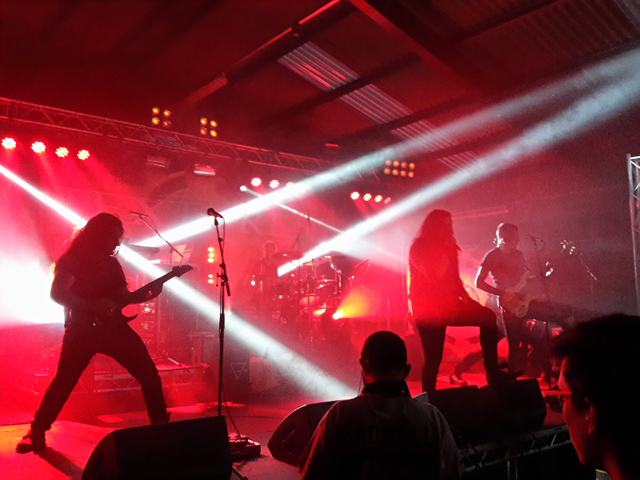
Predictably, considering their decision to call time after 16 years, melodic technical groove merchants Textures announced early on that this was to be their last TechFest. With the crowd immediately desperate to fully engage with their last chance to catch their heroes, frontman Daniel De Jongh picked the masses up in his meaty palm and carried them on a journey through their colossal back catalogue from “Drive”, “Regenesis” and “Storm Warning” to “Stream of Consciousness” and “Laments of Icarus”. The crowd-surfing was immediate; the circle-pit and moshing ensued. The band responded with shit-eating grins, breakdown after breakdown, juddering tech scrambles and a cacophony of battered drum-skins. The atmospheric backwash drifted over proceedings for “New Horizons” and the lightshow ramped up a level with sweeping spots and blazing strobes. The catcalls and whistles emanating from the crowd reached fever pitch between tracks and regular chants of “AY! AY! AY!” drowned out De Jongh’s attempts at banter. No matter, he simply waited then tore them a new arsehole with his barking vocal and skittish whoops. His range is unequalled; his rich quality of tone is to be marvelled at. Those with hair wind-milled, those with fists raised them. Then following the monstrous “Singularity”, the band broke for an unnecessarily long interlude of melodic synth. Blue lights from the stage, lighters from the crowd, but the momentum was lost, the wait monotonous. When they returned De Jongh actually felt the need to say “we’re back”. They did manage to pull it all back eventually but only by demanding a hangar-wide wall of death. The division between the fans and the onlookers immediately became apparent but those more up for the craic, soon pulled the strings of a circle pit together as the rhythm switched to a gallop. The band began pulling stunts like co-ordinated backward walks across the stage, the bassist gave up playing and allowed De Jongh to bang his mic on the strings to set the rhythm, the stage-jockeying began and the show began to descend into farce. Happily, the energetic nature of their songs and their performance pulled them through the roughest of patches and we all retired with buzzing ears and rosy cheeks. (JS)
The final word: as hoped for, this was a day of great bands, but what was particularly striking was the friendliness and natural camaraderie amongst everyone present. Even the security staff had smiles on their faces while doing their job efficiently. UK Tech-Fest world is one where people talk to strangers happily, make space for others and share their bottle of water. Band members are around to chat and everyone’s happy. World leaders please note.
Review: John Skibeat / Andrew Doherty
Photos: John Skibeat
Tuesday, October 2, 2012
Album Review: Mortor – Shoot ‘Em Up
Stuffed full of jagged, hammer-on, hammer-off ragers like “Under The Flag”, the blistering title-track and “Infidels” – tracks that come loaded to the gills with rumbling bass, furious speed metal and almighty Corpsegrinder-esque burbles – Shoot ‘Em Up is a no-frills assault on your lugholes. Yank up the volume and the vibration it generates at the bottom-end of your aural range is mesmerising. This thing is an absolute beast of an album. “Clusterfuck”, for instance, adds flesh to the dripping, glutinous form of the bog-monster that the early tracks outline. As the track notches down the pace, you can actually feel its feet thudding on the ground as it advances upon you, a muddy trail pooling behind as it lumbers on. This is one foul stench you cannot escape.
“Trigger Happy” has jerking rhythms and guitar leads that begin to introduce other more anthemic Amon Amarth-esque elements. There’s hints of that battle metal drama about moments like this and it’s brother “Locked And Loaded” that just induce more and more panic into the mix. Those guitars go a bit over the top in places, but that’s all part of the fun, isn’t it? And don’t get me wrong this is one fun album. It absolutely refuses to take itself too seriously and that is ultimately its saving grace. If it had made even the slightest attempt to hide its weak spots, Shoot ‘Em Up would be rendered instantly redundant. There is no black metal masking here (although “Days Of Our Knives” does flirt with breaking that fourth wall), no self-absorbed progressive elements to rub your beard knowingly to. Oh no. With track-titles like “Whiskey Surgery” and the utterly loco “Let’s Deflagrate” you can be sure this is all about having a good time.
Certainly, this kind of hammer-down tomfoolery has been practiced before (it kept reminding me of Austrian Death Machine, Swashbuckle and Six Feet Under for varying reasons) and don’t be fooled into thinking that there is a wild degree of track-by-track diversity. However, if you dig the sound of ten people playing drums at once and a farm animal for a vocalist you’re going to be all over this. It all boils down to your personal preference: you can take the 44 seconds of galloping, driven crush that constitutes the “Intro” and be left gasping for air and gasping for more or, alternatively, you can listen to the full 47 minutes and be slowly bludgeoned to death by madmen with lop-sided grins and inflatable hammers. The choice, as they say, is yours.
Also online @ The NewReview = http://thenewreview.net/reviews/mortor-shoot-em-up
Monday, July 9, 2012
Album Review: Periphery – Periphery II: This Time It’s Personal
Their follow-up is the cringingly-titled Periphery II: This Time It’s Personal. Yes, I thought it was a joke too. It’s a work that’s led me to wonder if, after their forthcoming concept release, Juggernaut, the next album will be called something equally tacky. Perhaps Periphery III: In Your Face or Periphery III: The Real Deal. Well, apparently the answer is “yes”. In a brief comment made by Mansoor recently, which includes the information that the lyrics in II actually reference III, their next album will be called the horrendously gimmicky Periphery III: Third Time’s A Charm. But, I digress.
This sophomore album sees the whole band taking on songwriting duties, as oppose to the one-man show of their debut, yet it still contains a number of reworked Bulb demos, so it’s a bit of a mixture and that does come across. As the title suggests it is, in general, less abrasive than their debut with much more of a melodic, colourful approach to tracks. The production values have been tightened a notch and the vocals have been thrust more to the forefront. Of course this brings Periphery into line with current trends for a more textured, ambient approach to the genre and the latter half of the album, especially, dangles its legs deep inside that concept. The first half is more of a patchwork quilt of chaos and order; battering groove and demonstrative lulls; hard-hitting roars and growls that dive into the kind of clean singing that is mostly pitched at the top-end – just the zone where Sotelo’s whine comes fully into play. Those who ducked for cover last time will be doing so once more.
The introductory posturing on “Muramasa”, for instance, is short and sickly sweet and quickly pitches us head-first into the crush barrier of “Have A Blast”. The spasmodic, mathy nature of the music here goes a long way to focussing our minds on the g-spots of each chorus and this pattern is followed deep into the album. A gnarly, pop-up electro-beat backed by reverb-heavy strings feeds into the jerky hammer of “Ji” and, at last, Sotelo rediscovers that tone that suits him best with some dark, throat-ripping growls and mid-range cleans. There’s a beautiful, cosmic wash lurking in the background here and some impressive stickwork from Matt Halpern that seeks to plug the gaps.
With other tracks creating gateways, like the hook-laden “Scarlet”, the chameleonic “Ragnarok” and the ambient layering and simplified structure of “Erised” sucking us in, and surprises such as the instrumental “Epoch” and all the craftily-integrated guest solos, the album stands a thousand times more accessible than their debut. Yet, there is far too much that simply passes by without ever finding its feet, and, ultimately, you’d really have to question if, at any point, Periphery hit the addictive bounce and lightness of touch that the most recent releases by Vildhjarta, Uneven Structure, Skyharbor and, even, Textures feature. All these albums simply hit harder and sink deeper into our psyches.
In the cold light of day, 14 tracks and 69 minutes (their debut topped 72 minutes) is a heck of a lot of material to wade through when so much of it ceases to shock and awe to anything like the degree that their debut so clearly did. But then, apparently, “this time it’s personal”, so perhaps we should allow them some leeway; some selfishness in their experimentation. Let no-one say you don’t get value for money with Periphery. Whatever the effect that this softening of the edges has had on their fanbase, they can be pretty proud of the fact that they’ve successfully managed to build another interesting level on their already solid foundation. We can only hope that, in the future, their talent for album titles remains so asymmetrically opposed to the quality of the material that lurks inside them.
Also online @ Ave Noctum = http://www.avenoctum.com/2012/07/periphery-periphery-ii/
Tuesday, July 3, 2012
Album Review: Baroness – Yellow & Green
Only a visual artist would name his band’s opuses Red Album, then Blue Record, then have us all guessing as to what colour was to follow. Go on. We were all guessing, weren’t we? The artist in question, of course, is John Dyer Baizley. He’s the man responsible for his and so many other bands’ artwork so, following the thought process that a painter’s primary colours would be blue, red and yellow, I plumped for Yellow. I certainly didn’t expect him to pull Green out the hat aswell. Of course, upon spinning this double-disc, I was naturally assuming Green to sound like a mix of Yellow and Blue Record, but I was wrong there too. Yep, Baroness have been experimenting… wildly.
First thing you’re going to notice is the vocals and you may balk at this information. There’s little to no snarls or roars (Baizley’s trademark bellowing howls of derision aren’t welcome here), the usual slathering of reverb has fallen away and a strong, doleful delivery has been brought into play. All these things bring the singing more into line with Torche’s clean, doubled-up approach. In fact there are several tracks that make parts of the album’s two halves work as neat brothers to Torche’s latest rumbler Harmonicraft. There’s no “Rays On Pinion” here, no “The Sweetest Curse”. Yes, it’s a shock. I’m playing it through right now for the umpteenth time and my face still looks like Janet Leigh’s when the knife cuts through her shower curtain.
So let’s start on Yellow. There’s plenty of old school influences here with a spot of Pink Floyd in “March To The Sea”, a dousing of Yes flamboyance and crude Sabbathian warble that licks around the languid psych of “Cocainium” and I’m even getting a King Crimson influence every now and again. It’s pretty dour fare for Baroness who previously have leeched innate joyfulness amidst their expansive constructions. If you’re looking for some of their signature clanging riffs and hearty passion, the closest you’re going to get is in the addictive yet crassly repetitious chorus, sweeped, looping effects and heavy fuzz of “Take My Bones Away”. In general terms, you’ll find a lot more clean notes here than ever before. There’s a dose of 60′s pop backing effects that walk alongside the folk acoustics of “Twinkler”, we get some 90′s indie-flecked shoegaze that punches its way through “Little Things” reducing it to a pretty uninspiring, insipid gloop, and there’s even a punkish gloom, a sonic curiosity that early R.E.M. albums boasted, in the driven pop of “Sea Lungs”. On the plus side, there’s plenty to dig on the rhythmical, rumbling gallop and reverse vocal effects of “March To The Sea” and in the dark underbelly of the 7-minute dream-pop of “Eula”, including a brazen, finger-powered wah-wah effect and a collusion of drum and bass aggression.
Turning to Green we find a work littered by space and plenty of witty, folk-fuelled pop. There are a couple of stars in “Board Up The House” and “Collapse”. The former is pure Torche with plenty of dirty fuzz, a kick-ass riff and a wired, dialled-in dual vocal whilst the latter is ripped with a dark acoustic grunge that softly squeezes layers of emotion through a backdrop of sub-aquatic, groaning effects. “Mtns. (The Crown & Anchor)” sways into view with a heart of bluesy pop and a fizzing effect on the vocals as, from here, Baroness carefully mark out Green‘s territory. Whether or not you are able to buy into the padding, languid pace of “Foolsong” or the sharply-plucked, instrumental lump of acoustic driftwood that “Stretchmarker” floats upon, will probably decide where you stand on Baroness’ softer side and genre-crossing freewheeling. For those who don’t, there’s a startling, pop-punk, twin-vocal attack (“Psalms Alive”) and a jagged, hit of Foo Fighters-esque alt-rock speed (“The Line Between”) to further confuse you.
I’ve always associated Baroness with bands like Russian Circles, Red Sparowes and Pelican, simply for their focus on a long-game of rampant melody and lavish structure. They have this uncanny ability to work from a subtle build to finish with a blood-pumpingly strong climax. Very little of that is left here. But to constantly look for what isn’t there would be criminal when what is there is so much more important. Here, they’ve created intuitive music that weaves in and out of moods, track by track. There is no plan, no desire to make do creating one style of music. It makes the album feel like a collection of lost songs; like they were created a long time ago but never quite suited Baroness’ style so never saw the light of day. Honestly, I wouldn’t have guessed the band in a million years had I heard this blind.
Ultimately though, the music feels exactly that – old. It’s intuitive music because it’s been heard before. Baroness have a good crack at seeking out an understated level of simplicity. Consequently, so many of the tracks emerge with just one trick up their sleeve. You can pretty much hear each attempt to focus on that one lyrical hook that defines the song. That, to me, shows the kind of naïvety that I never thought possible of a band whose past ingenuity has left me with goosebumps on my arms and a desire to immediately pick up a guitar. For those tracks here that do punch their way to the fore or, alternatively, simply refuse to be hurried along with their brethren, they break the mould.
Baroness seem to have gone through their entire palette creating Yellow & Green, their bravest and most honest work to date, but the end result is surprisingly lacking in colour.
Also online @ The NewReview = http://thenewreview.net/reviews/baroness-yellow-green
Friday, June 22, 2012
Album Review: The Elijah – I Loved I Hated I Destroyed I Created
The Elijah cite influences like Olafur Arnalds’ control of classical and electronic ambience and the experimental post-rock of This Will Destroy You but, more pertinently, the combination of feather-light touch and slap in the chops instantly draws comparison with Amia Venera Landscape and Devil Sold His Soul and, to an extent, Between The Screams and Rinoa.
Recorded in an abandoned country mansion in Shropshire, the band have utilised the structures’ natural reverb; the music reaching deep into those resonant recesses to dredge up a complex, textured and inherently bleak sound which they use to blanket the listener with. Whilst the instrumental beauty of “In Regret” is a track that allows for those many textures to be dissected, with its metronomic sweeping bows and harsh, hammering strings, the album’s heart and soul lies in the vocals. They sit atop this multi-layered wall of gently-shifting emotion like bricks and mortar on concrete foundations. Dan Tomley is the screamer, providing the blocky, vein-bulging angst, whilst Mike McGough is the crooner, the binding agent, smothering the cracks with a dark, sweeping sorrow.
Back to that question and here we are being sucked in by “In Misery”. Closing your eyes it’s easy to picture a turbulent, boiling surface of a horizon-filling ocean. When the moment arrives for Tomley’s roars to cut in they come without apology – “I can barely breathe, I can barely speak”, he falteringly croaks. Yet here, surrounded by gut-wrenching pain, they feel integral. Tracks like “In Death” and “I Hated” benefit similarly with “The thought that I have torn the smile from your pale-skinned face” being a barbed lyric that will worm its way in deep. However, throw those screams into direct conflict with McGough’s subtle hues, as they do at the very peak of “I Loved” and those foundations begin to sink, the cracks reappear and their is a sudden loss of cohesion between each element. The levels become overloaded and the listener can find thereselves overwhelmed as the basic instinct for “fight or flight” is triggered. That takes some getting used to, but those who stick with this can learn to stay hooked and possibly even love this. I’ll admit, I ran away like a little girl and it was a while before I crept back from behind the couch to press the “play” button once more.
Ultimately, it’s not the aggressively maudlin content or the clashing vocals that irk the most, it’s the repetitious nature of the tones and hues that leaves somewhat of a bad taste in the mouth. The Elijah have produced a debut album with sharp claws and hackles that are quick to raise during its darkest, most volatile moods. All well and good but, by my reckoning, they need to show a little more control and a touch more ingenuity if they are to stand out from their peers. Prepare accordingly.
Also online @ The NewReview = http://thenewreview.net/reviews/the-elijah-i-loved-i-hated-i-destroyed-i-created
Thursday, May 17, 2012
Album Review: Royal Thunder – CVI
The scene is replaying in my mind’s eye as I’m listening instead to the three-and-a-half minutes of agonisingly torpid, steadily-building drum rolls, the ballooning bass, the dulcet chimes and Wild West string-bends of the track “Blue”, from Royal Thunder’s debut album CVI. There are four crescendos in total here and at the climax of the last, when two of the guns fire and one of the men falls, the vocal kicks in. It makes for an interesting alternative to Morricone’s ultimately irreplaceable masterpiece.
There’s most definitely a kind of dark potency which lurks within Royal Thunder; they create mood music to inspire waking dreams such as these. The band boast an array of different styles and each roughly manages to inhabit its own character within that sun-parched circle. There are soft, emotion-inveigled, crystal-clear slowies like the “Sleeping Witch” and “Minus”, crawling, sludgy proggers like “Parsonz Curse” and “Shake And Shift”, and stone-cold rockers where the galloping drums and rolling riffs drive the music forward as the vocals suddenly begin to lose control like they do for “Whispering World” and “No Good”. Someone’s going to win this shoot-out and it’s probably going to be messy.
Mlny Parsonz’ vocal range is a huge part of what creates these factions. The fact she can go from the bluesy “Parsonz Curse”, where her vocal is at its most masculine, to the crystal clear femininity and gentility of the opening to the psych-tweaked “Drown” is jaw-dropping. One minute she’s summoning up the earthy, yet piercing quality of Robert Plant or Wolfmother’s Andrew Stockdale, using it to fend off the band’s slides back towards doom-mongering plod, and the next she’s flicked a switch, brushed off the dust, and turned herself into an Lennoxian angel (a reference to the crystalline vocal of Eurythmics’ Annie Lennox for those knowledge-seekers amongst you).
There is a small problem with CVI and the root of it lies in the way it divides its time. The top-half of the album is fast and loose, daring and boldly antagonistic, whilst the bottom-half is dark and laconic, drawing deep on the pipe of peace, blowing smoke rings around your head in an attempt to woo your soul out to play. You may equally enjoy both halves but, for the rest of us, we will tend to veer towards preferring one over the other. “South Of Somewhere” is a microcosm of this – it spends four minutes building softly from dustbowl winds, through chimes and lullabies, before ditching the ephemera to snap into a minute of howling punk rock. It’s insane.
Yet, Royal Thunder are startlingly talented. Their songwriting is ground-breakingly good because they aren’t afraid to take risks with it. CVI may not feel like an interconnected album as much as it feels like an eclectic cast line-up from a movie, but every character is fully-realised and absorbingly rich in detail. So, if you don’t completely buy into the simple beauty of “Minus”, then you surely won’t ignore the nine-and-a-half minutes of keen riffs, barbed hooks and scorchingly progressive fire that all lurk within “Shake And Shift”. There’s my gun-toting hero, right there; now I recommend you go check this out and find your own star.
Also online @ The NewReview (with samples) = http://thenewreview.net/reviews/royal-thunder-cvi
Saturday, April 28, 2012
Album Review: Torche – Harmonicraft
Compare it to their previous releases’ similarly cartoon-esque but most definitely bleaker pictures and you’re seeing images that clearly represent the band’s shift in musical styles. It’s true. Listen carefully to the sludge-infected monstrosity of their eponymous debut album and its much acclaimed follow-up, Meanderthal, which earned the band their “stoner/doom pop” label, and you can hear exactly how they came to arrive at this point and with that artwork.
I’m not going to beat around the bush any further. Harmonicraft is their cleanest, most melodic album to date and it’s release will continue to divide stoner, prog and post-metal fans in the way that Torche have always sought to do. They begin as they mean to continue, with 2 and 3-minute walled sections of rumbling bass that jimmy along cyclical riffs fired through distorted guitars. The band’s sparkle and main selling point here is that from somewhere amidst it’s hammering crush is the echoing, clean vocal of Steve Brooks. In an even purer form than heard previously, Brooks is your upbeat guide through the heaviosity, firing out his minimalistic lyrics, serenading his audience through the thick and the thin. Be it via the medium of punk rock for “Walk It Off” and “Kiss Me Dudely”, the grunge-soaked swagger of “Reverse Inverted” and “Letting Go”, or the chugging rock n’ roll pound of “In Pieces” and “Skin Moth”.
The songs are still trench-deep and busy enough to make your ears pop when they throw in a sudden shift in depth. It’s the yank-up into the guitar arpeggios and neck-snapping drive of “Snakes Are Charmed” you need to watch out for. It’s one of those moments where you know a band has nailed down something truly special. The hairs are standing up on the back of my neck now just thinking about it. They almost repeat the trick with the slow, neck-snapping groove of “Roaming” and the catchy-as-fuck rotating riff of the title-track – I reckon this is what being trapped inside Torche’s own washing machine is like, going round and round with those soiled tour threads.
With its track-by-track homage to looped riffery, Harmonicraft is, undoubtedly, a mood album. You flick it on, it invigorates you for 38 minutes, and then you move along. It’s not something you can easily dip in and out of. Each track feeds beautifully on to the next as subtle shifts in rhythm mean you simply roll with every single one of its punches. The down side of course is that they will face rows of pointing fingers who don’t buy into such a concept. For instance, there are several moments where the song demands more from the band than they’re willing to give. It’s not the first time we’ve heard them proffering only one and a half minute tracks and it’s hard not to feel aggrieved when a track you dig crashes to a halt with a sense of incompletion; the wish left unfulfilled. Would it work if you stitched all the tracks together by a series of chord hangs? I doubt it. Done this way, it can leave you with the vague impression that you’re being pitched too. The nay-sayers will be suggesting that if they really are an ideas factory, then why do so many of their imaginings sound similar? Ah, the trappings of being so clever, so innovative and so skilled are that your public will always question your motifs and demand more of you.
So, sure, at first glance it may seem that Torche are driving towards melding churning pop and gutsy groove together à la Queens Of The Stone Age, yet deeper inspection shows they have also begun to loop back in on themselves. There are songs here that brush-up against the kind of moods that Mastodon’s current work is offering and given the frowning, doomier finale that lurks in “Solitary Traveler” and “Looking On” (think Pilgrim meets High On Fire), we can see they are still keeping all their options open. End of the day, whatever their critics may say, Harmonicraft is a genre-bending original and I’d recommend it any day of the week. Without bands like Torche showing innovation like this, there’d be an awful lot of uninspired and uninspiring music out there.
Also online @ The NewReview
Friday, April 27, 2012
Album Review: Anathema – Weather Systems
The two-part ‘Unforgettable’ is something of an ambitious introduction; the first part weaving an upsurging, acoustic guitar arpeggio (an instrument you’ll hear plenty of) around Vincent Cavanagh’s velveteen vocals, and the second a piano-led, melancholic boy-girl duet which brings in more of Lee Douglas’ high-pitched, crystalline singing. Sitting up front the tracks feel like a bit of a sore thumb; the kind of demanding songs that would be far easier to swallow further down the playlist.
The rising panic of tracks like ‘The Storm Before The Calm’ and ‘The Gathering’ certainly get the heart racing. The former features an abrupt change of tack, lifting the pace under a deluge of white noise and programmed industrial touches, and the latter needs the reassurance of a few sideways glances at the bigger picture. It gets them by rubbing shoulders with ‘Lightning Song’, whose violins and acoustic guitar tug at the heartstrings only to walk us – smack! – into the punch of a muted electric guitar strike.
With each track linking back to the central theme, the album forms one steady circuit of the bases to form an enigmatically absorbing home run. You’ll identify with the central character of the piece when he picks up the baton, running with it across the dark inferences of tracks like ‘Sunlight’, ‘The Beginning And The End’ and between the hackneyed monologue of a near-death experience that weighs heavy upon ‘Internal Landscapes’.
Everything is, of course, open to interpretation, but having recently suffered a family bereavement I couldn’t help but see the album as the slow death of a confused and pained soul; a record that I found in some ways upsetting, as the emotions are still raw. Some of the lyrics may be honest but they seem to cut so deep. Viewed at different moments, though, the music proves complex enough to contain a less brutal side and offers several rays of light, so I may come to take comfort from it in the future.
Weather Systems is most certainly a bold move by the band, an attempt to lay bare, with honesty, the emotions that emanate from the subjects of loss, regret, pain and death. As singer Daniel Cavanagh has rightly pointed out, “This is not background music for parties. The music is written to deeply move the listener, to uplift or take the listener to the coldest depths of the soul”. A mission most definitely accomplished.
Also online @ TLOBF
Tuesday, April 24, 2012
Album Review: Skyharbor – Blinding White Noise: Illusion & Chaos
Nailing a worldwide release for their double-disc debut album, Blinding White Noise: Illusion & Chaos, can’t have been the smoothest of rides (“four years of epiphanies and disappointments” according to brainchild/guitarist Keshav Dar) but it’s easy to see how they got there in the end when you see which label they are gracing (Basick) or cast your eyes down the number of international guest appearances. Also bear in mind that these contributions are from guys who offered their help, not vice-versa. Guys like ex-TesseracT vocalist Dan Tompkins, whose pin-point tone is so obviously the key to the Skyharbor door-lock and consequently ends up singing on 80% of the album, and guys like ex-Megadeth axeman Marty Friedman who contributes to two tracks.
The majority of the content is made up by the Illusion disc and, honestly, it’s a delight to finally hear a modern progressive metal record that is happy to dip its toes in the waters of djent, but doesn’t feel the need to obstruct the flow of the songs with incessant levels of palm-muted hammering or flood you with wave upon wave of ambient wash. The band has allowed for a very organic writing process. Left unencumbered by heavy-handedness or complex mathematics the natural rhythms are left to flow and create instantly recognisable patterns. The production has followed suit and swapped hard, angular tones for a softened, more emotive backline that has put the vocal upfront and undominated. “Dots” is a straight-up joy, “Catharsis” is a brilliantly-layered puzzle with an undemanding solution, and “Celestial” burns with unambiguous, anthemic ambition (listen out for Friedman’s blistered, falling riff and Amogh Symphony’s Vishal J. Singh’s quixotic solo).
Any pent up anger that comes from holding back their instincts is released within the howling confines of Chaos. The band rip into the music with vigour, winding up the pace of their attack and rolling around in distortion and syncopation like pigs in muck. Sunneith Ravankar (Bhayanak Maut) is let loose to roar almost continuously through “Trayus” and “Aphasia”, but it is the split-personalities of “Insurrection” which invigorate the most as, like a spinning compass, the befuddling rhythm finally settles on a direction, both in its more turbulent and calmer guises. Throughout Chaos you get the sense that the heart of the album is still there, latent in the background, desperately fighting to burst through the surface as and when it can. And yet I am left with mixed-feelings about this segue into crushing heaviness. There are several bands who have mastered this kind of polyrhythmic, invasive bedlam already, so whilst it provides a deathly foil for the life-giving properties of it’s sister disc, to some extent it feels a little like the band are laying out their abilities to merely impress; an over-exaggerated evil, perhaps?
Illusion is far more beguiling and there is one particular work of art that sums up everything that is brilliant about Blinding White Noise. With intertwined rough and smooth layering pouring like colors out of “Maeva”, it’s a composition that, whilst forming just one more mountain top in a rolling range of peaks, is a piece of music that seems to transcend faceless labels. You simply couldn’t get away with calling it a “track” or a “song” without doing it an injustice, so I haven’t. At its core lies a series of spine-tingling change-ups that provide the platform for Tompkins to soak us in gloriously sweet emotion. His magnificent tone and eloquent words seem such a fitting place to end this review, so I’ll hand you over to him… “It’s so damn hard to let go / But take a chance / And survive, come together, embrace life / This is India!”
Also online @ The NewReview
Friday, April 20, 2012
Album Review: Tombstones – Year Of The Burial
Following the unleashing of Volumes I and II, Year Of The Burial is their third album in four years, so they aren’t slow in dishing out slabs of bollock-jangling power and this is like listening to Acid King meets Acid Witch with a good dose of Bongzilla’s weighty grunt thrown in.
With dissonance and sustain applied in biblical amounts, each blissed-out down-tuned chord strike gently warps and twists but never quite reveals itself. The qualities of that mile-thick buzz are best heard in the opening long down-strokes of ‘Egypt’, a track that sidesteps from an epic crush into a stone-cold driving groove.
Whether they’re zoning out for the slow burns like ‘Quintessential’ and ‘Unveiling’ or gently chugging along for the rollers like ‘Sabbathian’ or ‘Silent Voice’, that buttock-clenchingly deep buzz rumbles ever onwards; the unstoppable force. It’s a sound that just seems to improve exponentially the higher you wind the volume up. Set it to “deafening roar” if you want to really rattle your windows.
If you suddenly become aware of someone shouting at you, it’s probably not Mrs Haggis from No. 74; rather, it’s the lead vocalist. Sounding like he’s standing alone at the back of some vast cathedral, Bjørn-Viggo Godtland’s cries out to the rafters, summoning forth any and all evil spirits from their hiding places. His crystal-clean wails are strangely stark against such a mucky foreground, and you’d probably be able to understand him, if it weren’t for the lavish amounts of reverb that have been applied. Recorded live in an Oslo studio in the midwinter, it’s the little indiscretions and that sudden contrast that leaves you feeling, wonderfully, like you’ve stumbled on a forbidden, gothic black mass.
Somewhat disappointingly, the tracks do all seem to blur into each other after a while, but the stoner swagger of the title-track is a solid attention-grabber. It steps up the pace to awaken the guitars from their reverie and, as they cough out malignant riffs, Godtland drops pitch to a sneer and spits forth black wads of dread. Venomous and bristling with murderous intention, it’s a vaguely-cosmic, grim venture into yet more dark corners.
At a miserly 39 minutes, it does feel a little short. It takes that long to settle into the sluggish pace of the songs, so all too quickly you stumble on the classic denouement, ‘Sabbathian’. It features a steadily hammering chug-and-chant that carves its way through, predictably sourcing the creator of heavy music for one last heavy-lidded, disembodied ramble down the dark path. Strangely, it’s the perfect finale for an album that, by beginning slowly and ending with plenty of bang, serves as a fitting tribute to glorious doom in all its multiple forms.
Also online @ Ave Noctum = http://www.avenoctum.com/2012/04/tombstones-year-of-the-burial-soulseller-records/
Thursday, April 19, 2012
Album Review: One-Way Mirror – Destructive By Nature
When it comes to music though, if it’s cheesy there’s plenty of folks are gonna turn their noses up and walk away. Perhaps, it’s their die-hardened old school, true or cvlt moralistic standpoints, perhaps it’s the fact that cheesy music tends to come with a whole charade of gimmicks that puts them off (e.g.; bands that wear coordinated outfits or those that sell weird, often vaguely pornographic, merch), or perhaps they’ve been burned in the past by former musical loves turning bad on them. They may even have had a sense of humor bypass. Me, I love cheese and think it’s almost essential to have a couple of cheesy bands in your collection. Hell, stick on some lounge or some nu-metal and you’ll find me swinging from the nearest obscenely-ornate chandelier.
This, naturally, brings me to the enigma that is those crazy Frenchmen One-Way Mirror. Having previously reviewed the band’s eponymous debut, I thought I knew what was coming with their latest effort, but was a little shocked all the same. With Destructive By Nature, there’s still plenty of cheese on show here – even that sumptuous artwork looks like squeezy-cheese. It’s a veritable smorgasbord of the stuff; a pastiche of yellows, off-whites and blues; a cloud of faint aromas that suddenly burst into noxious whiffs. It’s heavier than before and they’ve most certainly expanded their overt range of production and post-production techniques. The whole focus here is on the incredible diversity of vocal styles booting you regularly in the ears ranging from single, double and treble-layered vocal, gang and crowd chants, obscured sections, electronically-tweaked gargles, fuzzed bits, bass-boosted parts, grunts, screams, cleans and scratched on/off versions. Trust me, if you had a one-way mirror you’d want to have it in their studio, so you could, without hurting the bands feelings, pull the kind of incredulous faces you will be pulling when you hear this. It’s along the lines of Figure Of Six getting chewed on by Threat Signal for doing a Mnemic impression.
Take the opening few bars of the album as an example. Put simply, they use it to introduce themselves. Literally. The kick-drum pads out the timing… “One!” (crowd roar) “Way!” (crowd roar) “Mirr-or!” (crowd roar). Cue big electronic sample and in bursts Rouxel’s full drumkit. Cheesier than a ball of edam. Oh, and they’ve got a press release to match – “This album is not unlike shrapnel as it will embed itself in your system upon explosion. Some songs will make the fans bang their heads while others will simply decimate them altogether”. A wonderfully ludicrous claim and, I’m sorry, but I beg to differ.
This all feels like a bit of a step backwards. I kept listening for the addictive qualities that tracks like “Destination Device”, “As You Are Now”, “Empty Spaces” or “Sockracer”, from their debut, had in spades. That “stand up and pump your fist” hook or the “sing your heart out” anthemic lyrics to kick in, but I kept coming up with shoulders shrugged and bottom lip protruding. The groove through tracks like “Face To Face” and “Straight Into The Wall” have a sinister underbelly but there’s just no firey contents inside whilst the stinging bitchslaps of “Soupracer” and “Deadly Shores” is all fire and no subtlety. It’s almost like, by creating reverberating highly-strung walls that dive into charred chugs and by boosting Perdicaro’s rumbling bass-drive, they’ve lost the ability to punch out kick-ass lines to go with it. The verses are virtually obliterated by theatrical posturing and there’s no simple-structured switch up from there, meaning that the choruses come and go without sticking in your noggin.
They do have a bit of a crack at mixing it up. The uber-heavy thrash that blisters the surface of “Wasted Years” is a welcome addition, there’s a memorably pained howl in the verse of “Inner Symphony” and there’s a couple of sweet soaring choruses in “Unexpected” and “Made In Vain”, where their softer side comes through. Sadly though there’s just too much overlap and too much filler here. It’s a shame as they suckered me in with their yummy debut, where the contrast between rough and smooth, hook and drive, was pretty much bang on. If you’re new to OWM then, remember, the whole thing takes some getting used to (and this certainly improves with age) but if there’s nothing that grabs you on that first spin, it’s unlikely you’ll return for another nibble.
Also online @ The NewReview = http://thenewreview.net/reviews/one-way-mirror-destructive-by-nature
Monday, April 16, 2012
Album Review: Heart Of A Coward – Hope & Hindrance
Heart Of A Coward’s debut album has been almost two years in the making, with the band jumping through more hoops than a San Diego dolphin, but at last the finished product is upon us and it certainly seems keen to impress. Let’s just say Hope & Hindrance (a clear reference to their multiple tribulations), covers many, many bases. Take “Shade”, which grabs at a piece of everything leaving the track bulging with content. The shadow: the spitting bellow of Graham’s “You’re nothing but a fucking traitor / Suffer, bitch”. The sparkling ray of light: his soaring cleans (re-recorded by Graham after original second vocalist Timfy James left mid-recording) – “What have you become? / You’re nothing.”
More shade. There’s that aforementioned, antagonistic thrash, plenty of gang chanting trying to wedge itself into your memory banks and maniacal progressions a-plenty; progressions of the sort that seem happy pitching Graham’s thick death vocal into wailing guitar, and that into epic soundscaping. Follow that up with some Meshuggah-esque hammer, as palm-muted battery meets Graham’s agonized, lycanthropic baying, for “Nightmare” and you’ve stumbled on the album’s dark heart. Of course, that all walks hand in hand with the hardcore fury, gang chants and crushing breakdowns that lurk within the monumental crush of “Around A Girl (In 80 Days)” and the first four machine-gunned minutes of “Break These Chains” (before it fully loses the plot for the remaining three and resorts to the equivalent of a slowly-recycling brick in a tumble dryer over a looped playback of Jean-Michel Jarre’s Oxygene).
More sparkle. There’s the twinkling riff that melts the heart of the title-track and the sudden bursts of TesseracT-ish dappling that fall at regular intervals throughout, mostly when you least expect them. Also, the dedicated ambient wash that the, appropriately titled, “Light” offers and the soft-touch melodics that litter the crystalline, wickedly-barbed choruses of “All Eyes To The Sky” and “We Stand As One”. I’m still struggling to believe how well Graham combines that mellifluous clean tone into the impressively cantankerous grot that more regularly flies from his gob, but for some reason it all seems to gel effectively.
Word of warning: this album definitely needs a fat-assed sub-woofer and plenty of volume to really blossom. I discover this after listening to it for the first week with naff iPod ear buds. Imagine my surprise then when I finally run it through my big-balled sound system. The opening rumble of “Motion” (this may have been retitled “Killing Fields” by the time you get it) makes the crockery rattle before dashing it all to the ground as Graham’s scarred roar kicks in. And, with the line “Smoke, mirrors, we won’t get out a-LIVE! We won’t get out a-LIVE! We’ll never be the S-A-A-A-AME”, I’m in pieces with the china.
Certainly, Hope & Hindrance is eager to please. Of course, the problem with all this to-ing and fro-ing between stylistic content is that the music takes a long time to bed in. It’s certainly a grower this one. I’ve been playing with it for a couple of weeks now and I still haven’t found its true value. It’s got heart, though, and like the recently-released debut by The Safety Fire, it’s bursting with potential. Yes, this baby packs more punch than a Klitschko brother and the balance between its light and dark sides is, pretty much, bang on. Sure, there’s still plenty of rough edges, fine and dandy for a debut, but if they can tighten their belts and nail the songwriting by upping the riffage quotient, applying a touch more gusto to the choruses and giving their vessel a more purposeful sense of direction, they’ll be true lionhearts in this reviewer’s eyes.
Note: This is an edited version of my review, following the release of a PR statement regarding the recording of the album. The original appears online @ The NewReview = http://thenewreview.net/reviews/heart-of-a-coward-hope-hindrance
Tuesday, April 3, 2012
Album Review: Ufomammut - Oro: Opus Primum
All of the band’s albums have a theme and Oro is no different. With a double meaning, encapsulated in its title, Oro combines the Italian palindromic word for “gold” and the Latin translation of “I pray” or “I speak”. The album itself delves into the concept of knowledge, power, fear and the human mind’s ability to distil those emotions into the kind of expensive bling you might find dangling from Mr. T’s bulging neck.
From the very first sounds of their aircraft powering down for ‘Empireum’, and the initiation of a steady speaker-to-speaker series of thrums and warbles, we are sucked from our burnt-out husks of lives and cast adrift into our own warped psyches by the music. The track builds from this point through emerging tom-thuds and snare-rolls, walking us down the spine of a twinkling riff, until we reach a battering crescendo of distortion, white noise and eventual overload.
Blacker, more menacing and far less captivating than the above are the tracks ‘Aureum’ and ‘Infearnatural’. The former drags us backwards through mud before hammering fuzzball chugs and dying vocals at us for 12 minutes or until we scream for mercy. It’s the more dastardly twin of those corpse-painted souls Primordial performing to the badgering rhythms of St. Vitus. With so many false endings it doesn’t seem to want to die, no matter how many times we hit it. The latter treads the same path with an even more sinister, all but obliterated, loop of spoken words.
‘Magickon’ returns to reprise ‘Empireum”s central riff, driving it through a couple of key changes, buzzing us back into oblivion. Hidden deep in the background are a series of vocalisations, a second track which only seems to become apparent when it begins to whine as it slowly sets about eating its own form. With ‘Mindomine’ venturing further into a wasteland of psychedelics, as monastic chanting leads us back towards Ufomammut’s penchant for cosmic drone, it’s something of a relief to spy the glowing exit sign.
Repeated plays allow a deeper connection to the changes of mood, the whole lysergic journey revealing itself as a maniacal descent into hell and back. Certainly, the message regarding the strengths and fundamental weaknesses of the human soul are potently clear. Despite my many reservations against repeating such a trip, it’s a message that I, somewhat worryingly, look forward to revealing further when they bring us the second half of the story.
Also online @ TLOBF = http://www.thelineofbestfit.com/2012/04/ufomammut-oro-opus-primum/
Monday, April 2, 2012
Festival Review: Hammerfest IV - The Hammer Of Thor
Within minutes of arriving, I hear brain-mangling tuneage blasting from the cracked doors of every visible chalet, I witness Captain America wrestling Spiderman to the ground and I’m soon being followed by a ten-foot Satan, a built dude dressed like the front-cover of Mastodon’s The Hunter and a rather attractive young woman on stilts, seemingly being eaten by an alien. It’s hard not to be moved by such scenes of complete metal immersion.
It’s not long before I’m banging my head along with the rest of my brethren as Trucker Diablo (3.5/5) let loose a volley of earth-shattering bottom-end groove from the depths of the on-site pub, the Queen Victoria (otherwise known as the third stage). The beer flows as an array of beards, of varying lengths, bob up and down with their owners and horns are thrown to the sky. Moving on to Chimaira (4/5), I quickly find myself reeling around the main stage pit as vocalist Mark Hunter peers down at his people, belching forth tracks from the band’s stunning new album The Age Of Hell. As the “Year Of The Snake” digs down to its earth-shaking dropped breakdown, the crowd slo-mo crunch together and time folds in on itself. It’s the peak of their show but, as it comes mid-set, it leads to the band coasting from here onwards.
Paradise Lost (3/5) follow up by ducking from goth-rock melodics into brooding doom and back again whilst, on the second stage, late additions Falling Red (3/5) dish up lashings of make-up and hairspray to go with their mile-wide stances and classic rawk. It’s not my cup of tea but the choons have got balls and, out front, there’s a sprinkling of gurning faces, so they must be doing something right. Headlining tonight, Anthrax (4/5) are clearly here to bring tha noize (sorry) and frontman Joey Belladonna works the gathered masses like a pro. A blazing “Indians” is the moment when the seated-VIPs can no longer resist and arise to begin rocking out with those who have been throwing shapes and hurling bodies for the duration.
With the excellent Evil Scarecrow (4.5/5) whipping up a storm of comedy and metal, those who survived the headliners begin to filter through and the lunatic quarter of Hammerfest begin to show their faces. Grown men in foil-covered cardboard boxes wade into the pit prompting plenty of laughs and pointing fingers as cries of “what the fuck is that?” hail from vocalist “Dr. Rabid Hell” (yes, really). One minute the band are lashing us with “Blacken The Everything”, a classy, post-apocalyptic powerhouse of a track, the next they are unleashing “Robototron” which reduces us to tears and has us dancing in squares. Even Lawnmower Deth (3.5/5) can’t top that, so I slip into the shadows to seek out the refuge of my chalet and my mattress.
As the sun rises on scenes of carnage, I find myself transfixed by men, still drunk from the night before, headbutting each other, one leaping from great height onto a stack of mattresses, and a few hardy souls swapping it all for a brisk walk along the nearby wind-blasted beach to scrawl rude pictures and words into the sand.
Back with the music and the blundering wake-up call comes fittingly from a duo called Oaf (3/5). Their first note is a foghorn in my cochlea. It threatens to empty the pub in one foul swoop, but it’s not long before “He Who Strums & Shouts” is settling into a devilishly heavy groove. AR (4.5/5) pick that vibe up and churn it into a barrage of driven, technical metal. Yet it is the fragmented vocal exhortations of vocalist Jhon Isaac that really fire this band into life. They initiate all manner of contortions to Isaac’s body and face, they inspire wild hopping from foot to foot and prompt bassist Simon Edwards to lead the crowd into taking part in the shenanigans. By the storming “One Day”, we are bellowing the word “spatula” back at the band, giving ourselves whiplash and grinning from ear to ear.
Over on stage two, Mortad (3.5/5) keep the party going with plenty of gruff screams à la Angela Gossow from the back-arching vocalist Somi Arian, whilst the main stage is padding its way through the uninspiring power metal of Germany’s Wizard (2.5/5) and the sleep-inducing, crown-of-thorns agonizing of Hell (2/5). That is until the devoted hit the battering ram that is Amon Amarth (3/5). Losing something in translation from the smaller stage, tonight they only really connect with the anthemic “Guardians Of Asgard” whilst the majority of tracks tend to lose their identity amidst an impenetrable wall of echoing guitar.
Wonderfully, Skindred (5/5) correct the balance as Benji Webbe orchestrates a packed house to swing their shirts above their heads, turn themselves into jack-in-the-boxes and dance until they drop. Ragga metal becomes a true force tonight, not just something to cleanse the palette, and, inevitably, it’s the bucking grooves of debut album Babylon that litter their set. From “Selector” and “Set It Off” to “Nobody” and “Pressure”, the build to the encore is one pile-driving monster to the next. By the time they sign off with the gargantuan “Stand For Something”, cosying up to The Prodigy’s “Breathe”, and the bullet-to-the-brain that is “Warning”, the crowd have melted into puddles and the world is on its head.
What a finale then to the most wild of weekends. The music may have finished us off but it was the sense of fun that will have us writing next year’s event in our diaries. The knowledge that those attending will be freely opening their chalet doors and inviting us inside to discuss their love of music is the key. There can be no doubting here, that the organizers have succeeded in marrying the word “metal” to the word “community”.
Also online (with more photos) @ The NewReview = http://thenewreview.net/show-reviews/hammerfest-iv-prestatyn-uk