Reviews Coming Soon
Tuesday, July 18, 2017
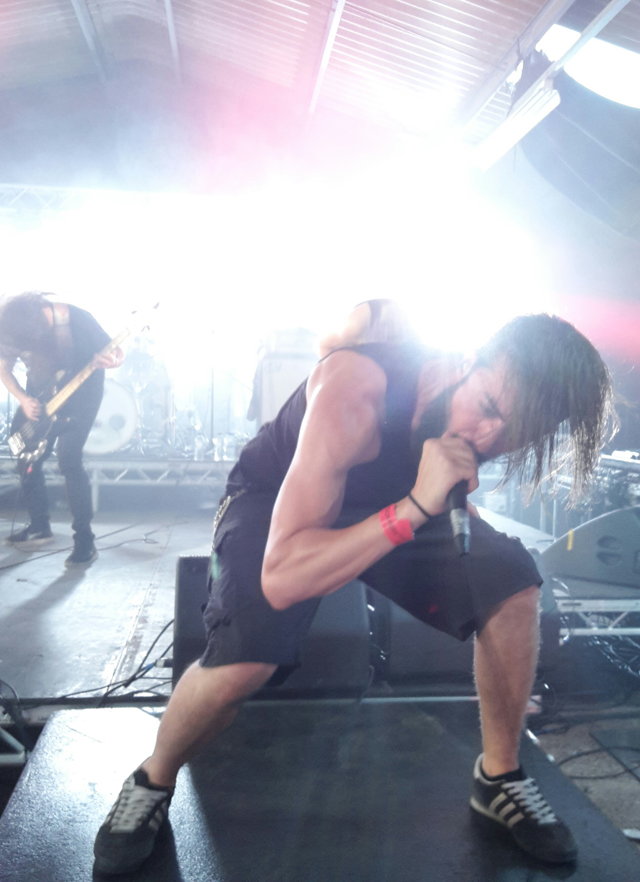
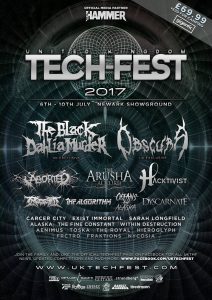
Live Review: UK Tech-Fest, Newark Showground, Saturday 8th July 2017
Johnski’s mission should he choose to accept it? Absorbing 7 hours of instrumental technicality; music sans vocals.
So what did he learn? Well, it imbued him with a new found appreciation of the drummer’s art. From the maniacally complex blur of sticks and feet on skin to the vast swathes of silence, deftness of touch and light glances of cymbal. The variety of percussion required when creating music devoid of the human voice was vast. And whilst there appeared to be a decreasing use of bass guitar there was conversely the increasing use of ambient recordings in this art form. It was also noticeable just how often certain instruments have risen to the fore in technical music over the years – see reviews for examples.
So… back to the present tense and the first band on the bill for the day. Altostratus, a quartet named after a high cloud formation, play a groovy, light, yet complex, form of technical rock with a soft, elegiac flow. Their bassist looms large in everything they do, setting a strong rhythm, striding wildly from step to step across the stage. The twin guitarists create some beautiful finger shapes, and aren’t afraid of palm-muting or riffing. They switch guitars regularly and at one point a small black box Strandberg guitar, no bigger than a banjo, is produced. Ultimately, they do thrash out one too many bar chords for my liking and just don’t work over their cute riffs for long enough to fully immerse yourself in their songs. Having said that, there are some wonderful flurries of colour to be found in key track “Hidden In A Cloud”. (JS)
Crushing bass lines, a growly vocalist, who looked as if he wanted to cause harm, and all-round heaviness were the meat and veg from Harbinger. Actually, not so much veg. The vocalist made the common mistake of mumbling song titles but I gathered beforehand from the guy on the merch stand that most of this set came from the recently released EP “Human Dust”. I loved the hard-hitting riffs, the heavy bass line and the technical hardcore energy. One vocalist briefly became two – that’s one way of getting over the noise. This was aggressive layered technical metal without ever being too clever about it. Structures held together well even in the onslaught of such brutal chaos. Harbinger had great presence too. The vocalist had grace and humour. Heads banged, faces twisted and the bassist in the multi-coloured shirt, which made me think that a blackcurrant-consuming bird had deposited its stuff, joyously lived and breathed every moment. The band rose to the occasion. This was everything you would hope for from a live performance. (AD)
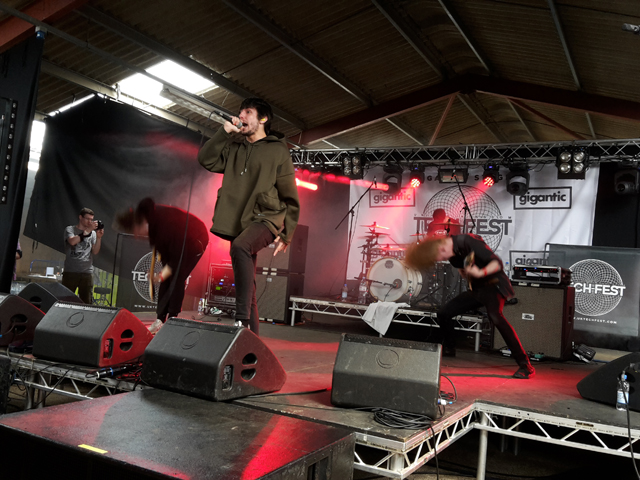
A thin and pale-looking man in a green hooded wind cheater growled and screamed like a cat, as the instrumentalists around him pumped out irregular, djenty dirt. It stopped. “We are Nycosia”, he announced politely in a refined accent. Thanks. Now back to screams and dissonance of a highly disturbing and entertaining nature. Green Man’s face turned redder as he rapped venom into his mic for our benefit. Oodles and oodles of energy and aggression poured out of every crevice. Chunk – clunk – chunk, they’re angry. Everyone’s angry but happy. Sampled distorted crawliness led to a further mentally deranged breakneck fury fest, breaking down somewhere along the line into mind-altering doom. Oompah-oompah. The experimentation knew no bounds. It was brutal. It turned punishingly dark out there. Somehow we finished up in a cosmic void. This was fine fare for 2 o’clock on a Saturday afternoon. Immaculately presented, this was warped music for creative minds. Well done. Does Nycosia come on prescription? Luckily Green Man didn’t burst a blood vessel. The man needs a nice cup of tea after all that. (AD)
With more Strandberg’s on display for Wisconsin duo (a trio for the tour) The Fine Constant, it certainly becomes apparent that it is this year’s instrument de rigeur. Adored by axe technicians for its lightness and adaptability, the guitarists here show just how adaptable they can be. Lead guitarist, Sarah Longfield, drives the twinkling top-end whereas the tour backing guitarist adds bassier textures with bar chords and riffs. Sarah’s finger shapes, speed and lightness of touch is astonishing and mesmeric in equal measure. She rarely visits the base of the guitar neck to strum, employing the finger-tapping method to great effect. Their music brings a strong arpeggio game, but sadly the performance and finished product feel vacant, like it’s missing something. Perhaps it’s the size of the stage, the loss of momentum between songs or the lack of engagement with the crowd, but for some reason the absence of vocal seems particular noticeable. (JS)
With less ambiguous arpeggios and a groovier soul, The Parallax Method, are three guys who obviously love what they do. Throughout the set, they’re exchanging smiles, teasing each other with new tricks and change-ups. Ben Edis on bass spends the whole set bobbing his head in time with his own rhythm, rocking gently forwards and backwards, and sandal-wearing guitarist Danny Beardsley isn’t far behind him. The drummer plays intense, rapid rhythms and displays huge technical skills. This band know their way around their instruments but they still fall short on variety. There is much similarity between the songs but what is there is solid. Pulling out of the groove to develop the layers would help lift what good foundations they have laid. (JS)
My immediate impression of seeing Exist Immortal on stage was that they are a well-drilled band. Co-ordinated head-banging, movement and horns gave a slick appearance. Musically, deep waves flowed through a heavily progressive sound. The singer mixed growls and clean vocals very well. Normally I pick up bands for having insufficient presence, but at the start I felt there was too much. All the gesturing and posturing were those of self-appointed, posing rock gods. The music itself had power and energy. There was plenty of energy in fact and moreover plenty of hair on stage to swing. And it flowed – the songs were strong, the riffs were solid and dark, and the clean vocals added impact to this melodic heaviness. The singer looked like Damian Wilson and when he spoke sounded like him. The vocal delivery was more akin to Scar Symmetry. Inciting the crowd to chant “we are non believers” was a bit daft, I thought, and the bassist became unhooked in his enthusiasm, but the stage performance settled down after initially being distracting. The crowd bounced, even the guy with the bandaged foot. I’d quite like to listen to the recorded version of these songs without the distraction of seeing these guys prancing about and without the wall of sound. I suspect they would be rather good. Well, on a hunch I bought Exist Immortal’s album “Breathe” (2016) so I guess I’ll find that out soon. (AD)
Maxi Curnow, producer, composer, fire-fighter and Tech-Fest favourite, always goes down well with the crowd and here it is no surprise to see just how well his unique brand of jazzy, progressive, groove-laden tech metal is received – he takes the adoration with a series of appreciative nods, thank yous and humble blushes. Further comment would be somewhat unfair seeing as, due to rumbling bellies, neither our intrepid reviewers got to witness his full set. (JS)
Dutch quartet, Exivious, featuring current and ex-members of Dodecahedron and Cynic, greeted us with the news that they were (like a couple of others) on their farewell tour. They certainly gave us a big echoing sound to absorb. Imagine yourself being in the belly of a whale, hearing the groaning of the ocean beyond its ribcage. Such was the impact of combining a multitude of effects pedals with an impressive and aggressive drummer. Some songs breathed fire, some froze in our veins. They certainly maintained a steely resolve throughout, their respective members smiling with each twist of the story conjured. Indeed, our lead guitarist seemed lost in his own little world; eyes covered by shades, ears covered by headphones, rocking and rolling his way to oblivion. With so little crowd interaction, the “all-male futuristic instrumental hit machine” left us a little bemused but certainly with something to mull over. (JS)
“Platfarm faave” was the sole contribution to humanity that I ever heard from the man on the gate at Hull Paragon station. It didn’t matter where you were going. It was always platfarm faave. The man was a legend. Not yet legends but also from Hull are The Colour Line. They certainly took the dull out of Hull. The band looked excited. Soon they were up and at us. Mayhem followed. The vocalist, guitarist and bassist ran around and jumped on things amid punk hardcore energy and noise. They wouldn’t stand still for Johnski’s photo, the buggers. The vocalist was in the moshpit and we were on the first song. I found myself confronted by the burly bassist. No time for chit-chat. It was carnage but let’s not forget they can play. Here was technical hardcore with extra ferocity but as a guaranteed bonus the rhythms were infectious and providing fuel. “I am extremely unfit”, announced the vocalist who set about disproving the point. Smash-bang-wallop: the noise was total, there was much kicking and screaming and hammering, and the songs were great. The vocalist reflected: “In our wildest dreams did we not imagine that so many people …. would be leaving the room at once”. The tension built up as “R.E.D” started with a tribal technical rhythm. The angry joy was abundant. Did I hear a little jazz insertion? Where to look? The singer was on the amp and in the crowd again. The guitarist jumped on the security guy’s shoulders. Leads got tied up. The guitarist stood on the drum kit. Heavy, heavy, thunder and chaos. The set was cut off at 4.30 but with a bit of persuasion all round, The Colour Line were back to play “Colonel Sanders Flying Machine” to delight us with more technical anarchy. And inevitably, orchestrated by the vocalist, it finished up with a mass pile-up of bodies in the middle of the floor. The guitarist confirmed to me later that the band is breaking up and they have just one more gig to play in their home city. That’ll be a riot. Newark 0, Hull 4. (AD)
It’s hard to believe that The Algorithm are a duo, albeit one with a neat symbiotic relationship, considering the level of noise that emerges from their respective tools. Whereas Jean Ferry batters various drums and cymbals with sticks, Rémi Gallego sends loop after loop skittering into the ether before backing it up all up with a chaotic set of tones and rhythmic patterns powered by synth and guitar. The effect is to place their music somewhere between dance and metal. It’s a destructive sound, bordering on drum and bass, prog and at times breakbeat. Occasionally, you’ll seriously wonder which instrument is playing percussion. Was that backbeat from the synth, the double-kick, or the guitar? The crowd are lapping it up and between songs shout “Oui! Oui!”, baying for the Gallic master-class to play on. With the drum-kit up near the front of the stage, it’s a pretty destructive sound. The force of the double-kick and the way it mashes with the guitar chugs (with the whole meshing to form what sounds like dog barks) bully your chest and lift you off your feet. They hammer through crowd favourites like “Brute Force” and “Deadlock” before letting their collective imaginations fly for “Floating Point” and “Machine”. Then, just for shits and giggles they attempt to scramble your psyche by tripping the light fantastic with “Access Granted” and that subversive section of ragga/dubstep. The circle pit slows from a mad-dash to a slow-motion jive and the party and, indeed, the day ramps up a level. (JS)
Compared to previous acts, the Gigantic stage hall was fairly empty, maybe on account of the fact that people wanted their dinner. Around 50 spectators gathered to watch Red Seas Fire. This band hadn’t set the world ablaze on the last occasion I saw them. Here again there was plenty of honest energy but what I heard seemed uncoordinated. The angry tech rhythm wasn’t especially angry. The clean vocals weren’t strong and were a bit whiny. The strength lay in the drums department. Here and there Red Seas Fire came out of their shell with all guns blazing and showed they were capable of rip-roaring, bouncing metal. Judging by the number of members of other bands in the audience, maybe Red Seas Fire could be seen as a band’s band. (AD)
My expectations were high for Uneven Structure. Other than segments, I hadn’t heard their latest album “Partition” (2017) before today, but their previous works and live performances told me I was going to witness something mesmerising, dark and epic. Normally silky smooth and lofty in spite or even because of the weight from the four instrumentalists, I found this set hard work as it never seemed to get going. Matthieu’s vocals haunt and float when he’s not growling, but here it was difficult for him to generate atmosphere above the wall of djenty noise. “Partition” evidently doesn’t engender fog. It does require immense sounds. Another guitarist appeared. The young drummer looked like was having the time of his life. The other instrumentalists exuded a mixture of gravitas and pleasure. This was too lyric-heavy. More atmosphere please. There was atmosphere and Uneven Structure built it up as is their wont, but this was no pressure cooker with ever increasing tension. “Partition” would seem to be a series of distinct experiences. I get that Uneven Structure would want to expand their sound, but it was as if Matthieu were making his lengthy vocal appeal through thick clouds. At one point the wall of sound accompanied a slow, lingering and emotional ballad. I’d not heard a djent ballad before. The power can be overwhelming. The complexity is haunting. It’s about tones of darkness. There’s little light here. It was impressive in flashes, but the sound mix and the lack of obvious logic in the musical story-telling wasn’t making this easy. Matthieu almost fell off the drum platform as he initiated a series of pungent explosions. This could be very heavy. The fog then appeared. The sad looking guitarist played a melancholic tune. The other two guitarists enigmatically faced the back of the stage as Matthieu sang and the drummer injected sophistication. The song built up and everyone was in the game again. The wall of sound and growls were as ever immense. The guitarist in front of me fell to the floor in exhaustion or emotion, not sure which. Fiery death metal followed. Matthieu incited the crowd. The crowd responded. The band lined up and subjected us to a wall of djent and enormity. Matthieu roared and floated dreamily above the deathly heaven. This was Uneven Structure of old – the start of Februus (2011) in fact. Finally, I felt uplifted. And it built up to a crescendo of power, ferocity and intensity. It was evident that the band felt it too. It was a magnificent ending but to this point I struggled with this set. The depth and complexity are unquestioned. Maybe if I’d known what “Partition” is about, it might have helped, but I felt that there was a lack of continuity coming from these heavy progressive tableaux. Matthieu struggled to rise above the intensity of sounds, and his message was lost for me. Yet in spite of my reservations and to some extent disappointment, this was still an impressive experience. (AD)
As I stood and watched the lads from Andorran death metal outfit Persefone warm up, it became apparent that something wasn’t quite right. Little clue did I have that I and the eventual audience were to witness something truly special. Just before they started playing in earnest, frontman Mark Martins Pia made a solemn announcement to the audience that their band-mate Miguel had been hospitalised before the show. However, they had agreed not to let the fans down and plough on despite no longer having a keyboard player, or backing vocalist, and as they had discovered, no compatible samples or effects (somewhat key to a complete performance). It later transpired, that they were also about to experience the full gamut of technical issues from loose ear monitors to PA system failure. However, true to their word, through shrugged shoulders, bit lips, hung heads and apologetic grimaces they “had fun” with it and put on an absolute stonker of a show. Having been accused previously of weak performances and crowd interaction, they tore into their set and constantly offered feedback, praising the crowd who reacted with nothing but joyous abandon and rapturous applause. Pia basically gave us a lesson in how important the bond between band and audience can be. He leapt from front to back of the stage; prowled from left to right. He climbed risers, speaker stacks, crowd-surfed and balanced precariously on the barriers with multiple arms supporting him. He even conducted the circle pit from inside it! The man was a tour de force. Yes, there were whole sections missing but where possible Pia sung (a surprise to even him) the clean backing vocals whilst the crowd hummed the missing samples. At one point this heroic frontman even ran to the front of the crowd to ram his mic under the lips of an intro-whistling crowd member for the masterful “Living Waves”. They improvised with a jam session to cram in “Spiritual Migration” and they climaxed with the epic “Mind As Universe”. When they laid their instruments down they found a multitude of new fans wanting to meet them to wish them and their missing brother well. This was a total master-class in going above and beyond expectations; of how to win friends and influence people and… to have a blast doing it. (JS)
Having misread the band’s logo beforehand, Obscura was a lucky dip choice for me as I knew nothing about them. That isn’t necessarily a bad thing. At least I was coming into it without pre-conceived ideas. A couple of knowledgeable people did tell me earlier in the day that Obscura are German and play technical death metal, which given this event isn’t so surprising. A potential distraction was the fact that I was bringing myself down after the improvised brilliance of Persefone. What I heard initially from Obscura was very technical, very clinical and very heavy. A sampled symphony did nothing to dispel a cacophonous high octane death metal song. This made way for another growly song marked by more heavily technical and purposeful progression. It moved along like an industrial machine. Progress continued to be mechanical, military even. I gathered that Obscura were from Munich and released albums called “Cosmogenesis” and “Akróasis” but for me it made little difference. Each song, wherever it came from, seemed to be borne of an apparent contractual obligation comprising the establishment of an unwavering technical pattern, growls and a clunking progression. Movements were made to order. The spokesman didn’t help by berating the audience for not being interested in the explanation of a song’s timing. He invited the audience to join in – to the growly parts? Band members smiled but there was no fun. There was no spirit or soul. “Sermon of the Seven Suns” was fast and hard but with the same technical riff it still managed to be colourless. To the band’s credit, they played well and tightly, and the grooves were good, but in spite of the occasional epic moment, this was all built on a classic model and came out flat and stingy for me. So whilst Obscura’s set wasn’t actually bad, there was nothing memorable. Once they were in a pattern, they found themselves stuck in it and it was all very pedestrian. To counter my own negativity Obscura have released four albums, and judging by the healthy crowd at the merch stand and a complimentary comment by a fellow-festival goer, it’s clear that Obscura have something to offer. I just never found out what it was. (AD)
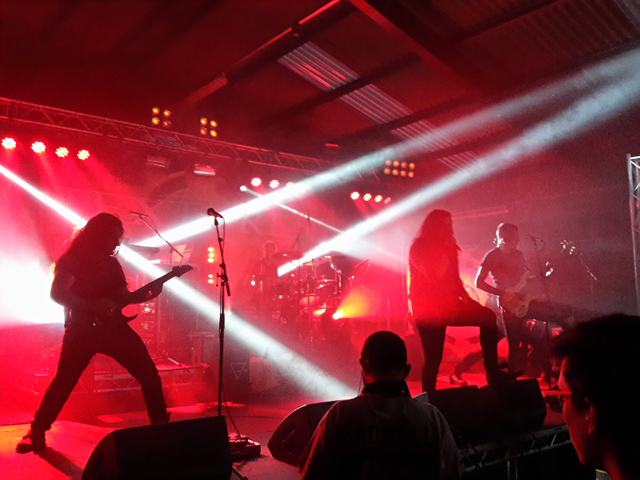
Predictably, considering their decision to call time after 16 years, melodic technical groove merchants Textures announced early on that this was to be their last TechFest. With the crowd immediately desperate to fully engage with their last chance to catch their heroes, frontman Daniel De Jongh picked the masses up in his meaty palm and carried them on a journey through their colossal back catalogue from “Drive”, “Regenesis” and “Storm Warning” to “Stream of Consciousness” and “Laments of Icarus”. The crowd-surfing was immediate; the circle-pit and moshing ensued. The band responded with shit-eating grins, breakdown after breakdown, juddering tech scrambles and a cacophony of battered drum-skins. The atmospheric backwash drifted over proceedings for “New Horizons” and the lightshow ramped up a level with sweeping spots and blazing strobes. The catcalls and whistles emanating from the crowd reached fever pitch between tracks and regular chants of “AY! AY! AY!” drowned out De Jongh’s attempts at banter. No matter, he simply waited then tore them a new arsehole with his barking vocal and skittish whoops. His range is unequalled; his rich quality of tone is to be marvelled at. Those with hair wind-milled, those with fists raised them. Then following the monstrous “Singularity”, the band broke for an unnecessarily long interlude of melodic synth. Blue lights from the stage, lighters from the crowd, but the momentum was lost, the wait monotonous. When they returned De Jongh actually felt the need to say “we’re back”. They did manage to pull it all back eventually but only by demanding a hangar-wide wall of death. The division between the fans and the onlookers immediately became apparent but those more up for the craic, soon pulled the strings of a circle pit together as the rhythm switched to a gallop. The band began pulling stunts like co-ordinated backward walks across the stage, the bassist gave up playing and allowed De Jongh to bang his mic on the strings to set the rhythm, the stage-jockeying began and the show began to descend into farce. Happily, the energetic nature of their songs and their performance pulled them through the roughest of patches and we all retired with buzzing ears and rosy cheeks. (JS)
The final word: as hoped for, this was a day of great bands, but what was particularly striking was the friendliness and natural camaraderie amongst everyone present. Even the security staff had smiles on their faces while doing their job efficiently. UK Tech-Fest world is one where people talk to strangers happily, make space for others and share their bottle of water. Band members are around to chat and everyone’s happy. World leaders please note.
Review: John Skibeat / Andrew Doherty
Photos: John Skibeat
Monday, September 26, 2016
Album Review: Tardive Dyskinesia - Harmonic Confusion
You see, Tardive Dyskinesia have an unfettered view of metal, so even if you’re not a specific fan of the progressive or technical stuff, you’re bound to suddenly find yourself nodding along due to the band drawing from such a wide range of sources. Motorhead, Gojira, Maiden, Meshuggah, Devin, Dragonforce – they’ve got all angles covered.
The first four tracks might just turn your brain to mush with its multi-part constructions but the deeper you dig, the simpler and less invasive the songwriting gets. “Insertion” introduces their passion for fast skidding chords. It’s a technique that pops up at regular intervals and by “Fire Red Glass Heart” one that has developed into spasmodic, polyrhythmic djent. It all soon releases into harmonised vocals then spinning off into techy runs and stoner roars before dropping into a slow-build of riff-picking. Smacks of Gojira and Textures are its bedrock but it’s the explosive lyric “You can run but you cannot hide” that provides the ultimate smack to the chops. “The Electric Sun” mashes Baroness’ sharp tones into Purified In Blood’s visceral delivery before dissolving into a Skyharbor-esque progressive wash.
Those hunting for a real crusher should skip straight to the Meshuggah-worship of “Self Destructive Haze”. It’s the aural equivalent of dropping a stink-bomb on a packed escalator. Even here amidst the bag of nails gargling and battering chugs they find a moment to breakout into a passage of uplifting chimes with accompanying vocoder. Listen very closely and you’ll pick out the true stars – the insane drum patterns and interlocking slap bass notation. As the album hits its middle, the band start opening out the structures; reducing the speed of their attack. Soon we’re wading into moments such as the arm-waving chorus of a “Thread Of Life” (inspired by Way Of All Flesh-era Gojira or I’ll eat my hat), the instrumental middle-switch and “Everlong”-aping rawk (yep, Foo Fighters) of “Concentric Waves”, the string-taps, arpeggios and jazz sax of “Savior Complex”, and post-rock noodling (a la Heights) of “Chronicity”.
The final shaking of Tardive’s creative box of tricks is saved until right near the end – “Echoes 213”. Its a track that ripples with expansive guitar soloing, progressive arpeggios, fluid rhythms and cosmic touches which provide the gentile comedown into dead air. It would be remiss of me to not also mention that, whilst listening, I was reminded of the kind of Deconstruction-level Devin Townsend production. That is about as fine a compliment that I can give.
So, are we excited? I am! Personally, the listening experience was a lot like the band had thrown down my vinyl collection and then reconstructed it from the shards. Yet, I’d be happy to point out that Harmonic Confusion is full of originality too. Sure there’s a wealth of inspiration here but it ain’t imitation. Tardive manage to reinvent their source material and keep each part flowing in the same direction to the same destination point. If this doesn’t get them noticed by the big players, then… well, I’ll eat my other hat.
Also online @ Ave Noctum = http://www.avenoctum.com/2016/09/tardive-dyskinesia-harmonic-confusion-playfalse-records/
Tuesday, February 9, 2016
Album Review: Textures – Phenotype
Let me just put on my Professor mortar board… Now, the “genotype” concerns each organism’s core genetic structure, whilst the “phenotype” concerns the morphology and development of the organism’s traits. Essentially the two albums are a study of nature versus nurture. The intention is for the musical structures on Phenotype to reappear within Genotype, only adapted to display the music’s origins – an attempt to mimic an aural version of genotype-phenotype mapping. Yes, it seems odd to release them that way around then (the “after” picture before the “before” picture), but there you go.
Heavier than Dualism, this sports a strong muscular base that draws on pistoning drums, spasming drop-chord structures and a thick, brutish death vocal roar. Echoing the immense wall of power generated by bands like Periphery and Monuments, the whole construct hammers its way into your ears, the driving rhythm rolls around in your skull and once complete emerges with a slowly dissolving echo.
Opener “Oceans Collide” grips like a vice as it builds and builds to an unbearable crush before abating like some of Uneven Structure’s more noisome compositions. Similarly, “Shaping A Single Grain Of Sand” bucks and brays like a mule, jerking from action to inaction, from clean to roared vocal. The closing Meshuggah-styled breakdown even leaps out of hold before it has had the chance to settle but gives vocalist Daniel De Jongh a chance to give it absolutely everything. Which brings us to “The Fourth Prime”. It concerns “the downfall of man” through imperfections within those in control. It is riddled with brutish chugs and zinging fingerwork and proves the switch of guitarist Joe Tal for Jochem Jacobs will ultimately be a smooth transition. Halfway through, the rumbling drop in pace reveals a vast, echoing cave of wonders which ends up being the perfect place from which to launch a renewed aural assault.
There are spots in some songs where the music begins to feel a little overwrought – “Erosion” and “The Fourth Prime” being good examples. At these moments proceedings become swamped by the multi-part construction; the sheer desire of the band to fill every available space with an army of intertwining riffs, leads and rhythms. It proves they are one talented unit of players but sometimes less is more and here there is a tendency for the natural flow to become stifled.
In a poppier, more melodious moment, “New Horizons” proves to be catchier and a heck of a lot more colourful. As vibrant as a halogen bulb, it glows like a deconstructed Killswitch Engage track. The subject matter is all about self-improvement and rising above any perceived limitation. Further relief from the thunder, can be found in “Zman” and closer “Timeless”. The former is a gentile little number that sports a sweetly-echoing, cyclical piano played by Uri Dijk. The latter provides the glorious wash of clean vocals that we were waiting for. It takes the joy of 2011’s “Reaching Home” and turns it into a mournful, emotional ride that describes the curse of a faulty genetic blueprint. It tugs at heartstrings, playing on our own perceived fears and failings with De Jongh driving home the impacting lyric “I heard you crawling, carrying your burden down the yearning hill”.
When all is said and done it’s not a faultless album. There are oddities that initially catch you out, like the drumtrack “Meander”, but even here there is much to draw strength from – it certainly serves as a gentle reminder to Stef Brooks’ incredible percussive work that goes on behind each track. The last album was a grower, and this will inevitably also take longer to fully ingest and appreciate the full impact of Textures’ constructions. No doubt, when all is said and done we have the portent of Genotype to follow and that promises to fulfil so much of Phenotype‘s true potential.
Also online @ Ave Noctum = http://www.avenoctum.com/2016/02/textures-phenotype-nuclear-blast/
Monday, March 2, 2015
Album Review: Izah - Sistere
“Indefinite Instinct” opens to a battering gale-force wind, before ticking over into hollowed-out, reverb-loaded, gargling roars. As the bass finally kicks in the space floods with colour and the track comes alive. There are the first rumblings of emotional discord as taped newsreels are freed to paint the canvass with real anguish and torment. We get a man protesting his innocence (“I don’t know what crime I’m supposed to have committed”) as the Cult Of Luna-esque progressions build layers in the background. “Demise, demise” roars the vocalist Sierk Entius as a series of effects and radio signal scrawl bring the piece to a close.
Considering his past experience, it seems reasonable to assume that producer Jochem Jacobs (ex-Textures) may have had something to do with the repeating themes that feature and he certainly handles the eclectic and complex layering with aplomb. There are shocks in store like the sudden, aggressive attack that mark out “Duality” and “Finite Horizon”. The former, themed around the horrorshow that was the Unabomber, utilises industrial drumbeats and Cavalera-esque groove that acquiesces to reveal a sinister background thrum. It is all so reminiscent of the dark progressions that feeds the music of No Made Sense and Kongh. “Finite Horizon”s groove rapidly decays into a screwy pattern of ISIS-esque clean vocal harmonies and tones, panicked riffs and tribal rhythms. Finding something for your senses to acclimatise to does become a chore when the ground beneath your feet moves so often. It seems a shame when each constituent part alone, would be so effective.
Thankfully, the 30-minute title-track properly hunkers down to fully dissect a singular concept. Here the story of a sobbing couple torn from each other’s arms yanks at your heart – “We belong together!”. There are strong black metal overtones with continuous double-kick and Dalek-like, atonal shrieks before the body of the track moves into elegant slow motion. At 20 minutes there are trumpets and a gentle deconstruction into radio scrawl, feedback, roaring amps and whale sound. It is the equivalent of the band leaving the stage only to return to play out a warm wash until “lights out”.
Sistere is a fearless debut that strides along exuding an elegant majesty. The band’s ability to combine sounds and feed each one into their melancholic concept is impressive. All the while they dig into their disturbing box of tricks improving the flow and engendering a sense of purpose. All this proves just how in control of their own destiny they truly are. Nordvis have bagged another winner here.
Also online @ Ave Noctum = http://www.avenoctum.com/2015/02/izah-sistere-nordvis/
Monday, September 12, 2011
Album Review: Textures - Dualism
One year later and we get Dualism. Our first listen through reveals that their core has, unsurprisingly, become a little skewed; the flavors within have changed. It is an album that varies much to the abrasively-consuming areas that the previous album, Silhouettes, inhabited. However, this isn’t necessarily a bad thing. In a sense, this is far closer to their earlier, more ambient debut, Polars. It’s more melodic than Silhouettes, cleaner, less intrusive and a whole truck-load more flamboyant. All this makes it a far more accessible album.
Instantly, you’ll notice the differences in vocal style that De Jongh has brought. I’ve always thought of him as a frontman who seems more comfortable singing than bellowing, and it comes as no surprise that, with Dualism, Textures have gone from being that band who roar with the occasional soar, to being that band who soar with the occasional roar. De Jongh with his excellent warm tones has retained a few elements of why Kalsbeek’s cleans always drew comparison with Mike Patton but from somewhere he’s managed to bring elements of Brandon Boyd as well – of course, Dijk’s cleverly-understated atmospherics merely add to that whole Incubus arena rock sound. Of course, you’ll still find a vast array of groove and progressive elements lurking behind most tracks.
Opener “Arms Of The Sea” is wholesome, deep and has a brutal pulse that drags you in until De Jongh finds his croon and serenades you into the surf that you’ve spent the first two minutes kicking up. You’ll find a much less chaotic cadence to the music than, I for one, expected. It will catch you out if you’re hoping to find another “Awake”, because instead you’re more likely to find another “Messengers”. “Reaching Home” has an unbelievably simple, addictive riff running through it’s lead-up to the verses and in combination with De Jongh’s stunningly strong and wonderfully melodious vocal they simply own the track. It’s a definite standout and it comes as no surprise to discover it’s the album’s lead single.
As usual, there’s much to admire about guitarist Jochem Jacobs’ production. He captures the vitality of the drums whilst retaining the throb of the bass, without which tracks like “Sanguine Draws The Oath” would just seem limp. Instead, they kick like a mule with sections of Gatling gun snare and string-bending bass taking them to a whole other level. It’s like listening to Periphery covering Faith No More or Circles duelling with TesseracT over the subject of who is the most “epic”. Dualism has, of course, got its weaker moments; the points where the band dip their toes into their more predictable pool of rhythms and sounds. Tracks like the metalcore-tinged “Minor Earth, Major Skies” or the poppy “Consonant Hemispheres” are a little lacking in punch and originality; they don’t seem to possess that explosive spark and, consequently, struggle to keep up with the rest of the album. However, most places you look, you’ll find a masterly performance in pacing and layering. Indeed, no finer example of this is to be found than that within “Burning The Midnight Oil” which benefits greatly from a lack of vocal. It allows the music to shine and helps you really identify and connect with the intricate piecing together of the different sections.
More important than anything here, Textures have created an album with a heart; an album with its own identity. Close your eyes and you can feel these two mighty hands reaching down to clasp you, creating a bubble of sound, effectively causing the outside world to simply fade away. The very first time I listened to the seven-minute post-rock soundscaping of “Singularity” I became ensconced in sound; whisked away until the levels dropped off and the bubble popped. Of course, there are those who will balk at the amount of clean vocals here, the sudden proximity that this album takes Textures to those alt-metal bands I have mentioned, as well as some of the more djenty metal bands who seem to be stealing all the headlines at the moment. It could be that this album may be looked on, in the future, as a watershed. Well, I was always partial to Textures before Dualism but, if anything, I dig these new flavors they’ve discovered even more. Though perhaps not as much as I dig prawn cocktail flavor chips. Om, nom, nom, nom.
Also online (with samples) @ The NewReview = http://thenewreview.net/reviews/textures-dualism