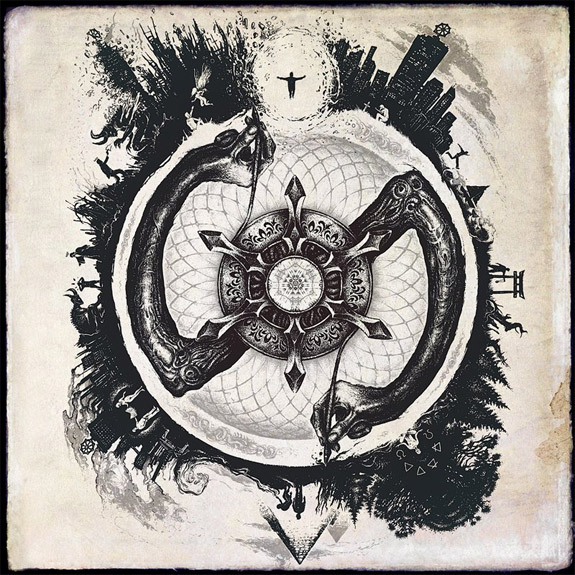
Dutch goliaths Textures are rapidly building quite a reputation for quality songwriting. Following the instant success of debut album Polars
they have gone on to build quite the back catalogue. All that
culminated in their finest work-to-date, 2011’s polyrhythmic
genre-morphing Dualism. For their latest trick they are planning a conceptual diptych, album one being Phenotype and album two being Genotype with both surrounding the subject of genetics.
Let me just put on my Professor mortar board… Now, the “genotype”
concerns each organism’s core genetic structure, whilst the “phenotype”
concerns the morphology and development of the organism’s traits.
Essentially the two albums are a study of nature versus nurture. The
intention is for the musical structures on Phenotype to reappear within Genotype,
only adapted to display the music’s origins – an attempt to mimic an
aural version of genotype-phenotype mapping. Yes, it seems odd to
release them that way around then (the “after” picture before the
“before” picture), but there you go.
Heavier than Dualism, this sports a strong muscular base
that draws on pistoning drums, spasming drop-chord structures and a
thick, brutish death vocal roar. Echoing the immense wall of power
generated by bands like Periphery and Monuments, the whole construct
hammers its way into your ears, the driving rhythm rolls around in your
skull and once complete emerges with a slowly dissolving echo.
Opener “Oceans Collide” grips like a vice as it builds and builds to
an unbearable crush before abating like some of Uneven Structure’s more
noisome compositions. Similarly, “Shaping A Single Grain Of Sand” bucks
and brays like a mule, jerking from action to inaction, from clean to
roared vocal. The closing Meshuggah-styled breakdown even leaps out of
hold before it has had the chance to settle but gives vocalist Daniel De
Jongh a chance to give it absolutely everything. Which brings us to
“The Fourth Prime”. It concerns “the downfall of man” through
imperfections within those in control. It is riddled with brutish chugs
and zinging fingerwork and proves the switch of guitarist Joe Tal for
Jochem Jacobs will ultimately be a smooth transition. Halfway through,
the rumbling drop in pace reveals a vast, echoing cave of wonders which
ends up being the perfect place from which to launch a renewed aural
assault.
There are spots in some songs where the music begins to feel a little
overwrought – “Erosion” and “The Fourth Prime” being good examples. At
these moments proceedings become swamped by the multi-part construction;
the sheer desire of the band to fill every available space with an army
of intertwining riffs, leads and rhythms. It proves they are one
talented unit of players but sometimes less is more and here there is a
tendency for the natural flow to become stifled.
In a poppier, more melodious moment, “New Horizons” proves to be
catchier and a heck of a lot more colourful. As vibrant as a halogen
bulb, it glows like a deconstructed Killswitch Engage track. The subject
matter is all about self-improvement and rising above any perceived
limitation. Further relief from the thunder, can be found in “Zman” and
closer “Timeless”. The former is a gentile little number that sports a
sweetly-echoing, cyclical piano played by Uri Dijk. The latter provides
the glorious wash of clean vocals that we were waiting for. It takes the
joy of 2011’s “Reaching Home” and turns it into a mournful, emotional
ride that describes the curse of a faulty genetic blueprint. It tugs at
heartstrings, playing on our own perceived fears and failings with De
Jongh driving home the impacting lyric “I heard you crawling, carrying
your burden down the yearning hill”.
When all is said and done it’s not a faultless album. There are
oddities that initially catch you out, like the drumtrack “Meander”, but
even here there is much to draw strength from – it certainly serves as a
gentle reminder to Stef Brooks’ incredible percussive work that goes on
behind each track. The last album was a grower, and this will
inevitably also take longer to fully ingest and appreciate the full
impact of Textures’ constructions. No doubt, when all is said and done
we have the portent of Genotype to follow and that promises to fulfil so much of Phenotype‘s true potential.
Also online @ Ave Noctum = http://www.avenoctum.com/2016/02/textures-phenotype-nuclear-blast/
Reviews Coming Soon
Showing posts with label tech. Show all posts
Tuesday, February 9, 2016
Wednesday, July 23, 2014
Album Review: Monuments – The Amanuensis
Amanuensis – a term used over the years to mean such things as slave,
aide, scribe and secretary. Sure, it’s a bit of a mouthful but then
here’s an album that’s got the depth of flavour, good looks, emotional
pull and addictive qualities to back that hefty handle up.
This sophomore song-driven album has drawn inspiration from the themes and motifs that connected the dots of David Mitchell’s Cloud Atlas novel and, if that wasn’t enough, it also taps into the mysterious Samsara cycle. Guitarist John Browne has described the latter as “the cyclical existence of life that we are all bound to.” Here he goes on to mention that “Chris (Barretto, vocalist) has written an entire story around the lyrics. Maybe that will see the light one day!” Intriguing stuff.
Recorded in Wales, North America and England, the production has been stripped back and recorded live, where possible, and it all comes without triggers and without studio trickery. They’ve also refined that same infectious, rhythmical, progressive groove that so marked out their debut Gnosis. The immediacy of these techniques are there for all to hear. These, of course, are features that are also being picked up by more and more bands now, but it’s a concept that has been around for far longer than Monuments. SikTh’s work has undoubtedly had an influence, but Monuments’ guitarist John Browne, originally with one of djent’s forefathers Fellsilent, is proof of that pedigree.
On the first listen, you’d swear the vocal layers on this thing are infinite. Chris Barretto (ex-Periphery, Ever Forthright) debuts with the band here and his experience and incredible vocal gymnastics lift the album to a whole new level. Throughout “Origin Of Escape” and the epic “Quasimodo” he’s tearing out lumps from your lugholes by firing out elongated roars that he bends into long, base-to-peak crecendos. During “Horcrux” and “I, The Destroyer” he fishes out those bowel-loosening piq grunts of his and for the remainder he’s scraping the skies with a sweet, melodic drift that gently echoes and swirls around inside your skull. On this performance, you’d be hard-pressed to find a better fit for this infectious band.
Playing Devil’s Advocate, you could perhaps find fault with the start-stop end to “Quasimodo” or the powered-down, monastic chanting that forms the soul-sucking closer “Samsara”. Both could be viewed as rather crass stylistic affectations that the album could do without. Also, the tight production does tend to crush the mix together a little too thickly, so you may find that you have to hunt for the big riffs and choral keystones. Certainly the feisty “This is the end of promises made that were never meant to hurt / Forget what I say, I just want to watch you burn!” of “I, The Creator” is a monster hook big enough to keep anyone happy but you might be hard pushed to find another to match it.
The stark reality though is that The Amanuensis takes a burgeoning genre and raises the bar for the rest. Seriously, you’d be hard-pressed to find another modern progressive metal album that could match this for impact. “The Alchemist” is the star track here. It also forms the central axis, directing the flow as it draws the rest of the tracks inwards. It knits the whole concept together; driving with a brutal force powerful enough to level cities yet retains the lightness of touch to draw the eye time and again. There’s even a game-changer in here in the form of “Jinn” with its majestic Eastern elements wickedly-woven into the fabric of the music. This is a completely, crushingly epic goliath of tech and groove; wall-shuddering, space-flooding both by design and in performance.
Also online @ Ave Noctum = http://www.avenoctum.com/2014/07/monuments-the-amanuensis-century-media/
This sophomore song-driven album has drawn inspiration from the themes and motifs that connected the dots of David Mitchell’s Cloud Atlas novel and, if that wasn’t enough, it also taps into the mysterious Samsara cycle. Guitarist John Browne has described the latter as “the cyclical existence of life that we are all bound to.” Here he goes on to mention that “Chris (Barretto, vocalist) has written an entire story around the lyrics. Maybe that will see the light one day!” Intriguing stuff.
Recorded in Wales, North America and England, the production has been stripped back and recorded live, where possible, and it all comes without triggers and without studio trickery. They’ve also refined that same infectious, rhythmical, progressive groove that so marked out their debut Gnosis. The immediacy of these techniques are there for all to hear. These, of course, are features that are also being picked up by more and more bands now, but it’s a concept that has been around for far longer than Monuments. SikTh’s work has undoubtedly had an influence, but Monuments’ guitarist John Browne, originally with one of djent’s forefathers Fellsilent, is proof of that pedigree.
On the first listen, you’d swear the vocal layers on this thing are infinite. Chris Barretto (ex-Periphery, Ever Forthright) debuts with the band here and his experience and incredible vocal gymnastics lift the album to a whole new level. Throughout “Origin Of Escape” and the epic “Quasimodo” he’s tearing out lumps from your lugholes by firing out elongated roars that he bends into long, base-to-peak crecendos. During “Horcrux” and “I, The Destroyer” he fishes out those bowel-loosening piq grunts of his and for the remainder he’s scraping the skies with a sweet, melodic drift that gently echoes and swirls around inside your skull. On this performance, you’d be hard-pressed to find a better fit for this infectious band.
Playing Devil’s Advocate, you could perhaps find fault with the start-stop end to “Quasimodo” or the powered-down, monastic chanting that forms the soul-sucking closer “Samsara”. Both could be viewed as rather crass stylistic affectations that the album could do without. Also, the tight production does tend to crush the mix together a little too thickly, so you may find that you have to hunt for the big riffs and choral keystones. Certainly the feisty “This is the end of promises made that were never meant to hurt / Forget what I say, I just want to watch you burn!” of “I, The Creator” is a monster hook big enough to keep anyone happy but you might be hard pushed to find another to match it.
The stark reality though is that The Amanuensis takes a burgeoning genre and raises the bar for the rest. Seriously, you’d be hard-pressed to find another modern progressive metal album that could match this for impact. “The Alchemist” is the star track here. It also forms the central axis, directing the flow as it draws the rest of the tracks inwards. It knits the whole concept together; driving with a brutal force powerful enough to level cities yet retains the lightness of touch to draw the eye time and again. There’s even a game-changer in here in the form of “Jinn” with its majestic Eastern elements wickedly-woven into the fabric of the music. This is a completely, crushingly epic goliath of tech and groove; wall-shuddering, space-flooding both by design and in performance.
Also online @ Ave Noctum = http://www.avenoctum.com/2014/07/monuments-the-amanuensis-century-media/
Labels:
amanuensis,
barretto,
djent,
fellsilent,
groove,
metal,
monuments,
periphery,
progressive,
samsara,
tech,
technical
Subscribe to:
Posts (Atom)