Having previously written music with effect-saturated vocals, the Swedish quartet have gone for instrumental, more synth-driven pieces this time around, apparently due to Kristian Karlsson’s (bass, vocals) recent heavy touring schedule playing keys with Cult of Luna. Guitarist Gustav Almberg has commented that “I guess this has helped us to take the band into a bit of a new direction sound wise“.
Richly-layered, warm and emotive the album opens on the thumpingly heavy “Ikaros”. The synth fizzes, the drums pulse and the guitar fires off arpeggios to keep the whole piece drifting along. There’s short snatches of something akin to 80s computer games lurking in there too all leading to the maniacally crazed sandstorm finish.
Moving through the driving thrust and distorted bass of “Off The Beaten Path” we alight at the oblique Giorgio Moroder-esque synthetic wash, poppish dynamics and cinematic trickery of “Monolith”. Here, the music begins to stab and test the listener to create a force that unites the pacier groove of the kind displayed by Station-era Russian Circles with the dark tones and blackened crush of the sorely-missed ISIS.
It does become apparent as you dig deeper that the subtlety of this particular instrumental album often means the music slips into classic rhythmic shapes (four-four beats, elongated stretches without rise, fall or melody, etc.). In these moments, you’d usually find lyrics or instrumental solos. Here, pg.lost have resiliently left their music undeveloped and, yes, uncluttered as it is, each piece is given room to breathe. It’s certainly a matter of taste whether you buy into that styling though. I have to confess I crave a more developed, instantaneous instrumental sound but that’s just me.
Stretching 7 songs over a 53-minute runtime, the band certainly rely on the listener taking time out to appreciate the music. Those with short attention spans need not apply. It’s just too easy to freewheel past the gentler or more simplistic tracks like the title-track or “Deserter”.
Happily they do like a good rumble to finish up so you’ll probably be shaken awake for the stark, bristling ambience of “A Final Vision”. It’s a joy that is every bit the equal of the wonderful, naturalistic flow that If These Trees Could Talk seem to generate so effortlessly.
At the end of the day, despite its impressive dynamic range and lush sonics, it doesn’t really add a great deal of new ideas to this rapidly-expanding genre. Despite that, it’s still a thoroughly solid addition from a record label that is getting a habit for polishing rough diamonds.
Also online @ Ave Noctum = http://www.avenoctum.com/2016/10/pg-lost-versus-pelagic/
Reviews Coming Soon
Showing posts with label russian. Show all posts
Wednesday, October 12, 2016
Friday, December 4, 2015
Album Review: Arrakis – Ammu Dia
Instrumental metal isn’t necessarily everyone’s cup of tea but it’s most
certainly a genre that lends itself to emotional abandonment. And with
post-metal burgeoning, it seems everyone’s at it these days. Another for
the melting pot, Greek three-piece Arrakis formed late in 2012 with the
intention of creating the ultimate stoner experience. None of these
messy lyricisms for them, just pure, pounding rhythms, heaps of
distortion and cyclical riffs into which the listener can blithely
stagger and drop out.
Recorded live in the studio, Ammu Dia shows promise but lacks punch. Roughly produced, its consequently loaded with honesty and raw power, yet is somewhat imbalanced and has plenty of niggling inaccuracies. Thematically lacking also, the album relies all too often on mere stringwork to discover the heart and soul of the tracks, rather than by using layering and soundscaping to dig into the emotional bedrock. Bands like Russian Circles or Red Sparowes are masters of both, whilst Arrakis attempt to fuel a different fire. They are more about the riff and the head-down groove. Only the final few tracks, and in particular, both “Noema” and the 12 paper-thin minutes of “Diplomacy?” even attempt to draw a little introspection from the listener.
With just the single lead guitar forging ahead to mingle with the battering kit and gutsy bass there’s little room for string interplay and, as a consequence, the big bloated monsters of one-dimensional “Audium” and the anomalous “Aztec” create nothing but a swathe of flat noise, losing what little craftwork there is in the muddy production and heaving dissonance. One recognisable touchstone lurks as “Oppose” tips its hat to the dark patterning and simplistic doom of both St. Vitus and Black Sabbath.
As a jam in a live setting with their chords blasting through chests, Arrakis have the tuneage to really make bonces bounce, but with so little to offer in this crudely-produced recorded format they are unfortunately just more of a racket.
Also online @ Ave Noctum = http://www.avenoctum.com/2015/10/arrakis-ammu-dia-sr/
Recorded live in the studio, Ammu Dia shows promise but lacks punch. Roughly produced, its consequently loaded with honesty and raw power, yet is somewhat imbalanced and has plenty of niggling inaccuracies. Thematically lacking also, the album relies all too often on mere stringwork to discover the heart and soul of the tracks, rather than by using layering and soundscaping to dig into the emotional bedrock. Bands like Russian Circles or Red Sparowes are masters of both, whilst Arrakis attempt to fuel a different fire. They are more about the riff and the head-down groove. Only the final few tracks, and in particular, both “Noema” and the 12 paper-thin minutes of “Diplomacy?” even attempt to draw a little introspection from the listener.
With just the single lead guitar forging ahead to mingle with the battering kit and gutsy bass there’s little room for string interplay and, as a consequence, the big bloated monsters of one-dimensional “Audium” and the anomalous “Aztec” create nothing but a swathe of flat noise, losing what little craftwork there is in the muddy production and heaving dissonance. One recognisable touchstone lurks as “Oppose” tips its hat to the dark patterning and simplistic doom of both St. Vitus and Black Sabbath.
As a jam in a live setting with their chords blasting through chests, Arrakis have the tuneage to really make bonces bounce, but with so little to offer in this crudely-produced recorded format they are unfortunately just more of a racket.
Also online @ Ave Noctum = http://www.avenoctum.com/2015/10/arrakis-ammu-dia-sr/
Labels:
arrakis,
circles,
groove,
instrumental,
post-metal,
red,
russian,
sparowes
Thursday, August 6, 2015
EP Review: The Bridesmaid – Grayson
Someone wiser than me once said “You can’t judge a book by its cover”. Ignoring such wise council, I find myself pre-judging the latest disc to land on my disc. Robert Høyem, who has also created art for bands like Sahg, Heksed and Kampfar, has conjured a really beautiful cover to accompany this EP from London-based instrumentalists The Bridesmaid. Picturing a religious figure lost deep in prayer it glows with an eerie presence. Mimicking the effect of woodcut art, his subject matter is all very suggestive of something spiritually ominous, possibly with black metal overtones lurking within and, if not that, then certainly music with an extreme, penetrative construct. The reality is a propulsive sound that, at times, dips its toes into emotionally soothing waters.
The track-titles suggest connections to the names of explorers of continents, rivers and even outer space. The tracks, however, struggle to marry up to my hypothetical concept (try the We Lost The Sea’s deeply-moving “A Gallant Gentleman” if you like the idea and require closure) so I realise I must stop. Diving back into Grayson then with an open mind then… Opener “Oates” crackles into life and slowly builds drawing on warm glossy tones, much like those that colour Skyharbor’s latest single “Evolution”, before releasing into “Ives” which heads deeper into the darker, choppier waters of other instrumental post-rockers like Russian Circles and Pelican. Here the yawning, melancholic backdrop stands in contrast to the driven groove which never quite allows it to get away or develop organically.
Happily, “Aldrin” does offer some evolving panic and heavy action before releasing into a sweet, repeating series of keyed strokes. Only here does it feel like any instrumental lead role is being taken to replace the absence of vocal colouring. The pattern of riffs visit several touch points and eloquently guide the listener along through a strong sequence of shoegaze and post-metal. “Ballack” follows suit in grinding out a darker path without ever quite finding its voice. And therein lies the problem with Grayson as a whole. It doesn’t engage or challenge the listener beyond those initial bursts.
Of course, I understand now why I felt a compulsion to create meaning within. Unguided, experiencing this EP felt like walking into a stranger’s room full of strange objects and even now, after the tenth play, it feels like a record without a mooring. It’s the lack of a lead element that has cast it adrift. Perhaps their future works will feature enough running time to invite true introspection and perhaps then a connection to the contents will follow more naturally.
Also online @ Ave Noctum = http://www.avenoctum.com/2015/07/the-bridesmaid-grayson-sr/
The track-titles suggest connections to the names of explorers of continents, rivers and even outer space. The tracks, however, struggle to marry up to my hypothetical concept (try the We Lost The Sea’s deeply-moving “A Gallant Gentleman” if you like the idea and require closure) so I realise I must stop. Diving back into Grayson then with an open mind then… Opener “Oates” crackles into life and slowly builds drawing on warm glossy tones, much like those that colour Skyharbor’s latest single “Evolution”, before releasing into “Ives” which heads deeper into the darker, choppier waters of other instrumental post-rockers like Russian Circles and Pelican. Here the yawning, melancholic backdrop stands in contrast to the driven groove which never quite allows it to get away or develop organically.
Happily, “Aldrin” does offer some evolving panic and heavy action before releasing into a sweet, repeating series of keyed strokes. Only here does it feel like any instrumental lead role is being taken to replace the absence of vocal colouring. The pattern of riffs visit several touch points and eloquently guide the listener along through a strong sequence of shoegaze and post-metal. “Ballack” follows suit in grinding out a darker path without ever quite finding its voice. And therein lies the problem with Grayson as a whole. It doesn’t engage or challenge the listener beyond those initial bursts.
Of course, I understand now why I felt a compulsion to create meaning within. Unguided, experiencing this EP felt like walking into a stranger’s room full of strange objects and even now, after the tenth play, it feels like a record without a mooring. It’s the lack of a lead element that has cast it adrift. Perhaps their future works will feature enough running time to invite true introspection and perhaps then a connection to the contents will follow more naturally.
Also online @ Ave Noctum = http://www.avenoctum.com/2015/07/the-bridesmaid-grayson-sr/
Labels:
bridesmaid,
circles,
grayson,
pelican,
post-metal,
post-rock,
russian,
shoegaze,
skyharbor
Friday, September 12, 2014
Album Review: Steny Lda – Beloe Bezmolvie
The infinite joys of throwing Russian track titles at Google Translate
and watching it explode is tempered somewhat by the bleak,
monosyllables that emerge from it. Lumps of wording like “Stern Wind”,
“Ice Storm, Ball Above Earth”, “In Black Sun Rays” and “Endless Snowy
Expanses, Illuminated Radiance, Eternally Cold Stars” still resonate
despite their cumbersome quality.
It’s no surprise then to discover that the PR blurb professes this to be a thematic work exploring “the power of cold, its northern and Antarctic nature, and the grandeur of eternal winter”. That thought is drilled home by the album inlay of snapshots of sailors fighting raging seas and glacial locations. Obviously, it’s something of a disappointment then to discover the music feeling so luke-warm. The seemingly endless, subtly shifting synth backdrops are austere in tone but the string work is rich, plump and vibrant and the drums patter along at an untaxing, gentile pace.
Swimming in the same post-metal waters as bands like Russian Circles, Isis and Red Sparowes, Beloe Bezmolvie (or White Silence) opens up with “Fordevind”, a wave-battering crush that confusingly shares its space with calm waters and soft surf. There’s also something enigmatically graceful about the 11-minute “Ledjanoj Shtrom…”. From an opening, almost balletic, emotive riff to the 3-minute directionless, warbled ending the whole ensemble mimics the piece-by-piece joyful storytelling of Russian Circles when their theme demands that they be venturing into the dark, forbidding spaces of Cult Of Luna.
Wonderfully, just as you think the album has run adrift, the wreck breaks on these twin glacial outcrops – the blunt death metal of “Svincovo-Serye Oblaka…” and the doomy “Drejfujushhie V Tumane Ajsbergi…” Here, the beast finally roars and beneath all the clamouring, the crafty score finally reveals its blackened soul.
It’s intriguing that Sterny Lda seem to have no problem with emotion when it comes to dishing out the hard and fast tracks – “Beskrajnie Snezhyne…” and “Soprovtilenie…” are both songs that successfully kick up a storm. However, when they need to apply a more delicate touch to extract a different emotion they do struggle – You’d hope that conveying the psychological torment of the bleak and the endless wastelands of the Artic might be something to get your teeth into, yet “Holod Zemli” is frustratingly a somewhat toneless, sluggish and ultimately hollow attempt when compared alongside that of others.
Some good, some bad and something of a sheep in wolf’s clothing then, but ignore the theme, look deeper and you’ll still discover plenty to get your teeth into.
Also online @ Ave Noctum = http://www.avenoctum.com/2014/09/steny-lda-beloe-bezmolvie-slowburn/
It’s no surprise then to discover that the PR blurb professes this to be a thematic work exploring “the power of cold, its northern and Antarctic nature, and the grandeur of eternal winter”. That thought is drilled home by the album inlay of snapshots of sailors fighting raging seas and glacial locations. Obviously, it’s something of a disappointment then to discover the music feeling so luke-warm. The seemingly endless, subtly shifting synth backdrops are austere in tone but the string work is rich, plump and vibrant and the drums patter along at an untaxing, gentile pace.
Swimming in the same post-metal waters as bands like Russian Circles, Isis and Red Sparowes, Beloe Bezmolvie (or White Silence) opens up with “Fordevind”, a wave-battering crush that confusingly shares its space with calm waters and soft surf. There’s also something enigmatically graceful about the 11-minute “Ledjanoj Shtrom…”. From an opening, almost balletic, emotive riff to the 3-minute directionless, warbled ending the whole ensemble mimics the piece-by-piece joyful storytelling of Russian Circles when their theme demands that they be venturing into the dark, forbidding spaces of Cult Of Luna.
Wonderfully, just as you think the album has run adrift, the wreck breaks on these twin glacial outcrops – the blunt death metal of “Svincovo-Serye Oblaka…” and the doomy “Drejfujushhie V Tumane Ajsbergi…” Here, the beast finally roars and beneath all the clamouring, the crafty score finally reveals its blackened soul.
It’s intriguing that Sterny Lda seem to have no problem with emotion when it comes to dishing out the hard and fast tracks – “Beskrajnie Snezhyne…” and “Soprovtilenie…” are both songs that successfully kick up a storm. However, when they need to apply a more delicate touch to extract a different emotion they do struggle – You’d hope that conveying the psychological torment of the bleak and the endless wastelands of the Artic might be something to get your teeth into, yet “Holod Zemli” is frustratingly a somewhat toneless, sluggish and ultimately hollow attempt when compared alongside that of others.
Some good, some bad and something of a sheep in wolf’s clothing then, but ignore the theme, look deeper and you’ll still discover plenty to get your teeth into.
Also online @ Ave Noctum = http://www.avenoctum.com/2014/09/steny-lda-beloe-bezmolvie-slowburn/
Monday, April 28, 2014
Album Review: Pet Slimmers Of The Year – Fragments Of Uniforms
What’s in a name? Having formed in 2008 you’d imagine that, had this
Peterborough post-rock unit called themselves Fluvial or Miasma Theory
[insert your own evocative sobriquet here], you’d imagine that they’d
have been gracing a major label a lot sooner than January of this year.
Instead, having consulted Schott’s Almanac “annual awards”
section, they plumped for the odd, yet alerting moniker of Pet Slimmers
Of The Year. It may not seem a fit match for their music, but it always
guarantees a chuckle.
Formed from the ashes of prog-metallers A Thousand Fires, they have taken their time writing, touring and building contacts and now, with a little help from their producer, Devil Sold His Soul’s Jonny Renshaw, they feel finally ready to drop this immense debut album on us. It’s a work that combines the abundant colours and rich vastness of Pelican’s layering and the melancholic tones and industrial fervour of Russian Circles. This of course is all mere groundwork emotion when compared to the way that the music both leaps out of the speakers at you and yet also slips so deftly into your subconscious. Honestly, the album sounds more like finding the middle ground between the twin majesties of Isis and Junius. Time and again you’ll hear these behemoths emerging from the gloom like two ships drifting inexorably towards each other through dense fog.
Following the gentle echoing groundwork laid by “Arterias”, they ramp up the layering, establish a solid groove and throw in some Russian Circles-esque skiddy strings for “Gathering Half The Deep And Full Of Voices”. Next up, they establish their range. No sooner has “Tides” taken us floating up into the ether and offered a featherlight touch none to dissimilar to that exhausted by Devin’s Ghost, then they drop us down into the black, boiling ocean of “Mare Imbrium”. It is here amongst the crush of the waves where they find their artistic zenith. As menacing as the mid-section of The Ocean’s Pelagial, as visceral as Isis’ Wavering Radiant, the surges of power and dark purpose take us crashing through every trough and every peak.
As a mainly instrumental band, they do use vocals sparingly (on tracks 1, 5 and 8) and merely as a soft, emotion-soaked extra instrument and one can’t help but feel slight disappointment at a trick missed. Most certainly, you can only imagine the extra dimension that an Aaron Harris-type earth-splitting roar could add to the mix. Instead, they err on the side of shuffling their way through the songs which offers the worrying potential of finding themselves lost within the absolute swathe of post-everything miserabilists out there. “Days Since I Disappeared”, for instance, wallows too long in its own melancholia and comes within a raw scream from taking them down that well-traveled road. Of course, they seem quite capable of saving themselves from this potent threat by stirring in songs like “Churning Of The Sea Of Milk” (clearly the bastard son of Isis’ “Not In Rivers, But In Drops”) and “La Tormenta” (another riotous stormer with a strong early grip and a broken, edgy quality).
Although the flow of the album is exceptional, Pet Slimmers do need to find more variation from somewhere. They seem at their most comfortable when they are offering up pounding gristle to chew upon. It’s only in these heaviest moments that their music seems to come alive. In the long run though, this classy trio have still managed to produce something exciting and beguiling. Fragments Of Uniforms is a magnificent, mouthwatering long-player and I for one will be desperate to see how this all translates to the live arena.
Also online @ Ave Noctum = http://www.avenoctum.com/2014/04/pet-slimmers-of-the-year-fragments-of-uniforms-candlelight/
Formed from the ashes of prog-metallers A Thousand Fires, they have taken their time writing, touring and building contacts and now, with a little help from their producer, Devil Sold His Soul’s Jonny Renshaw, they feel finally ready to drop this immense debut album on us. It’s a work that combines the abundant colours and rich vastness of Pelican’s layering and the melancholic tones and industrial fervour of Russian Circles. This of course is all mere groundwork emotion when compared to the way that the music both leaps out of the speakers at you and yet also slips so deftly into your subconscious. Honestly, the album sounds more like finding the middle ground between the twin majesties of Isis and Junius. Time and again you’ll hear these behemoths emerging from the gloom like two ships drifting inexorably towards each other through dense fog.
Following the gentle echoing groundwork laid by “Arterias”, they ramp up the layering, establish a solid groove and throw in some Russian Circles-esque skiddy strings for “Gathering Half The Deep And Full Of Voices”. Next up, they establish their range. No sooner has “Tides” taken us floating up into the ether and offered a featherlight touch none to dissimilar to that exhausted by Devin’s Ghost, then they drop us down into the black, boiling ocean of “Mare Imbrium”. It is here amongst the crush of the waves where they find their artistic zenith. As menacing as the mid-section of The Ocean’s Pelagial, as visceral as Isis’ Wavering Radiant, the surges of power and dark purpose take us crashing through every trough and every peak.
As a mainly instrumental band, they do use vocals sparingly (on tracks 1, 5 and 8) and merely as a soft, emotion-soaked extra instrument and one can’t help but feel slight disappointment at a trick missed. Most certainly, you can only imagine the extra dimension that an Aaron Harris-type earth-splitting roar could add to the mix. Instead, they err on the side of shuffling their way through the songs which offers the worrying potential of finding themselves lost within the absolute swathe of post-everything miserabilists out there. “Days Since I Disappeared”, for instance, wallows too long in its own melancholia and comes within a raw scream from taking them down that well-traveled road. Of course, they seem quite capable of saving themselves from this potent threat by stirring in songs like “Churning Of The Sea Of Milk” (clearly the bastard son of Isis’ “Not In Rivers, But In Drops”) and “La Tormenta” (another riotous stormer with a strong early grip and a broken, edgy quality).
Although the flow of the album is exceptional, Pet Slimmers do need to find more variation from somewhere. They seem at their most comfortable when they are offering up pounding gristle to chew upon. It’s only in these heaviest moments that their music seems to come alive. In the long run though, this classy trio have still managed to produce something exciting and beguiling. Fragments Of Uniforms is a magnificent, mouthwatering long-player and I for one will be desperate to see how this all translates to the live arena.
Also online @ Ave Noctum = http://www.avenoctum.com/2014/04/pet-slimmers-of-the-year-fragments-of-uniforms-candlelight/
Wednesday, October 30, 2013
Album Review: Pelican – Forever Becoming
“In a chronically leaking boat, energy devoted to changing vessels is more productive than energy devoted to patching leaks” – Warren Buffett.
It’s certainly a nifty quote that seems to sum up how instrumental post-rockers Pelican have handled the loss of guitarist Laurent Schroeder-Lebec. Rather than lament his undoubted songwriting talent, they have decided to sink their teeth into a whole new sphere of attack and, aided by the faultless integration of Dallas Thomas and his love for the big, brassy riff, they have dragged their sound out of the doldrums and into the kind of powerful groove-mongering that ignited fellow Chicagoans Russian Circles‘ career.
Forever Becoming, Pelican’s fifth full-length, is an album full of surprises. It seems that, somewhere along the line, expectations of it pre-release had fallen and, judging by the flurry of mediocre reviews that have been rushed out so far, it has been sorely underestimated post-release. There’s no doubting that perceptions of the band will have changed in line with their new artistic direction, but considering the album has to be listened to as a whole to be fully appreciated and will probably perform most admirably in the live arena, it seems a bit too early to be nailing it to a cross.
Oddly, their previous efforts have all featured strongly in their recorded formats, but have never shaken souls when performed. The reason for this may be that each one’s lighter touches and deeper level of atmospheric layering can so often get lost in the sound-desk, the roof cavities or the ether. Combine that loss with their music’s expansive drift and their “heads down” approach to performance art and you can imagine the fleeting impression they make on the less ardent fan. That will all change now that Forever Becoming has dropped – its almighty bottom-end and relentless groove will snap necks and burst chests.
The tour-de-force, ‘Deny The Absolute’, is nothing less than a conveyor belt of riffs. One after another after another, the guitar patterns cycle and build, each welding itself to the track’s backbone – a combo of surprisingly uncomplicated drum thunder and an equally compelling bassline that grinds and fizzes throughout. Together this all creates a series of wall-to-wall grooves that will swallow everything in its path. ‘The Tundra’ sucks up a little piece of High On Fire‘s sludge-packing inferno and breathes back a bitter rancour that ditches itself into a swaggering rut that rumbles forth down a doom-ridden path into gritty feedback. ‘Immutable Dusk‘ flexes more stoner muscle pitching bass-loaded menace and winding aggression into a series of warmer tones that rapidly completes their reformation into a confident position of power.
What’s most impressive about all this is that they haven’t just sandblasted their former attack to achieve this razor-sharp edge. They have blended the new with everything that has made their albums so eloquent in the past, beefed up on the parts that needed bolstering, tightened their focus and produced an album that flows from track to track with a silken elegance. Gone are the zig-zag of emotions and the song-by-song paucity. No, you can simply lose yourself in the basal journey of Forever Becoming and emerge out the other side believing it to be one single thread. As an example, the eight-minute two-tiered multi-coloured wanderlust of ‘Thredony‘ clashes heads with ‘The Cliff’ which in turn touches base with the motivational bliss of ‘Vestiges‘ in such a way that you would hardly notice the dip between the threesome.
When they do back off, we get the album bookends. Polar opposites, opener ‘Terminal‘ offers a soft foray into the darkness, backed by a hefty heartbeat of falling tom strikes whilst the stunningly rich, glorious tapestry of closer ‘Perpetual Dawn’ provides wave after wave of warmth and euphoria to bathe in. They form the preface and appendix to the book that you simply can’t put down. Once you turn that page, absolute absorption in the rhythmic drive and mind-expanding layering is not an option. It’s the aural equivalent of having all your pleasure receptors firing off at once. They haven’t showed anything like this kind of combined dexterity, determined pacing and gut-deep fury before.
Enforced change can be such a difficult process, so the initial human reaction is to fear the unknown, to err on the side of caution. Pelican, however, have laughed in the face of such dithering and have grasped their opportunity with gusto, swapping their elegant sailing boat for a stonking great powerboat and, boy, ain’t it a beaut. With turbos like the one on this bad boy, they really are ready for lift off. Keep your eyes peeled for those end of year lists – judging by its sleek lines and almighty wake, Forever Becoming should feature strongly.
Also online @ Heavy Blog Is Heavy = http://www.heavyblogisheavy.com/2013/10/29/pelican-forever-becoming/
It’s certainly a nifty quote that seems to sum up how instrumental post-rockers Pelican have handled the loss of guitarist Laurent Schroeder-Lebec. Rather than lament his undoubted songwriting talent, they have decided to sink their teeth into a whole new sphere of attack and, aided by the faultless integration of Dallas Thomas and his love for the big, brassy riff, they have dragged their sound out of the doldrums and into the kind of powerful groove-mongering that ignited fellow Chicagoans Russian Circles‘ career.
Forever Becoming, Pelican’s fifth full-length, is an album full of surprises. It seems that, somewhere along the line, expectations of it pre-release had fallen and, judging by the flurry of mediocre reviews that have been rushed out so far, it has been sorely underestimated post-release. There’s no doubting that perceptions of the band will have changed in line with their new artistic direction, but considering the album has to be listened to as a whole to be fully appreciated and will probably perform most admirably in the live arena, it seems a bit too early to be nailing it to a cross.
Oddly, their previous efforts have all featured strongly in their recorded formats, but have never shaken souls when performed. The reason for this may be that each one’s lighter touches and deeper level of atmospheric layering can so often get lost in the sound-desk, the roof cavities or the ether. Combine that loss with their music’s expansive drift and their “heads down” approach to performance art and you can imagine the fleeting impression they make on the less ardent fan. That will all change now that Forever Becoming has dropped – its almighty bottom-end and relentless groove will snap necks and burst chests.
The tour-de-force, ‘Deny The Absolute’, is nothing less than a conveyor belt of riffs. One after another after another, the guitar patterns cycle and build, each welding itself to the track’s backbone – a combo of surprisingly uncomplicated drum thunder and an equally compelling bassline that grinds and fizzes throughout. Together this all creates a series of wall-to-wall grooves that will swallow everything in its path. ‘The Tundra’ sucks up a little piece of High On Fire‘s sludge-packing inferno and breathes back a bitter rancour that ditches itself into a swaggering rut that rumbles forth down a doom-ridden path into gritty feedback. ‘Immutable Dusk‘ flexes more stoner muscle pitching bass-loaded menace and winding aggression into a series of warmer tones that rapidly completes their reformation into a confident position of power.
What’s most impressive about all this is that they haven’t just sandblasted their former attack to achieve this razor-sharp edge. They have blended the new with everything that has made their albums so eloquent in the past, beefed up on the parts that needed bolstering, tightened their focus and produced an album that flows from track to track with a silken elegance. Gone are the zig-zag of emotions and the song-by-song paucity. No, you can simply lose yourself in the basal journey of Forever Becoming and emerge out the other side believing it to be one single thread. As an example, the eight-minute two-tiered multi-coloured wanderlust of ‘Thredony‘ clashes heads with ‘The Cliff’ which in turn touches base with the motivational bliss of ‘Vestiges‘ in such a way that you would hardly notice the dip between the threesome.
When they do back off, we get the album bookends. Polar opposites, opener ‘Terminal‘ offers a soft foray into the darkness, backed by a hefty heartbeat of falling tom strikes whilst the stunningly rich, glorious tapestry of closer ‘Perpetual Dawn’ provides wave after wave of warmth and euphoria to bathe in. They form the preface and appendix to the book that you simply can’t put down. Once you turn that page, absolute absorption in the rhythmic drive and mind-expanding layering is not an option. It’s the aural equivalent of having all your pleasure receptors firing off at once. They haven’t showed anything like this kind of combined dexterity, determined pacing and gut-deep fury before.
Enforced change can be such a difficult process, so the initial human reaction is to fear the unknown, to err on the side of caution. Pelican, however, have laughed in the face of such dithering and have grasped their opportunity with gusto, swapping their elegant sailing boat for a stonking great powerboat and, boy, ain’t it a beaut. With turbos like the one on this bad boy, they really are ready for lift off. Keep your eyes peeled for those end of year lists – judging by its sleek lines and almighty wake, Forever Becoming should feature strongly.
Also online @ Heavy Blog Is Heavy = http://www.heavyblogisheavy.com/2013/10/29/pelican-forever-becoming/

Labels:
becoming,
blog,
circles,
fire,
forever,
heavy,
high,
johnskibeat,
pelican,
post-metal,
post-rock,
russian
Wednesday, October 23, 2013
Album Review: Russian Circles – Memorial
October is the month when the two leading instrumental post-rock groups right now, Russian Circles and Pelican, will go head-to-head with their album releases. Pelican’s newbie, Forever Becoming, dropped on the 15th and this Russian Circles album will go global two weeks later. With
both Chicago bands mining the same rough musical seam, you’d think the
two might have clashed sooner, but it has never been an issue previously
because of their distinct stylings. However, of late, Pelican’s albums
have been heading into the heavier, more groove-laden territory of
Russian Circles, whilst Russian Circles have been experimenting with the
more emotional layering that was Pelican’s calling card. So with
both albums coveting the same aural space, which should you be spending
your hard-earned cash on?
Lucky for me that’s a loaded rhetorical question as are the minefield of hypothetical questions that it should inspire someone to ask the pair of them. Thankfully, Russian Circles have many other skills that define them so that if both bands continue on this collision course, they might just miss each other by a whisker. The trio are a band known for their love of earthy grooves and skidding strings. These things are present and correct in this latest release with “Deficit” skidding with the best of them and “Lebaron” showing off more groove than a Massey Ferguson. In the past, they have also had a penchant for the immense, teasing build but that is less of a feature here with only “Burial” approaching anything close to the full crescendo.
What’s changed most notably of all, especially over their last couple of albums, is the number of times they plump for the aching beauty of a soft, multi-layered soundscape. Each one of “1777″, “Ethel”, the tacked-on intro “Memoriam” and it’s elegiac title-track reprise all pull on the heartstrings by evoking images of vast sweeping panoramas; the band plunging us into the heart of a bubbling ocean or pulling us up to gaze upon a torrid sonic vista. All the tracks have been treated to a well-polished production. Brandon Curtis has worked hard with the band to create the effects they wanted and bassist/keyboardist Brian Cook has had a large part to play in the process.
There is a strong synth mark stamped on this album and that has been key to the change of focus for the band. It’s presence has resulted in the peripheral level of introspection that Russian Circles’ instrumentals sometimes evoke being ramped up into an experience that becomes disconcertingly intense as you progress through. The songs will transport you to disconcertingly personal places and moments so that with each new movement, comes a new experience. Focus the mind and “Memoriam” is suddenly nothing more than a slow, two-chord whispering wind, which whips up into a gale as the battlefield of “Deficit” is revealed – the horses hooves, rat-a-tat drums and call to arms are all present and correct.
Likewise, “1777″ has the power to dump you onto Industrial Age streets where a steady bowing sound rings out and pistons pile-drive their way into an eventually seizure. Here, the music has a more visceral keenness to it with dark, menacing tones. Dig deeper and you’ll discover the desert plains of “Cheyenne”, the ocean swells of “Ethel”, right through to the warbling night creatures that inhabit the title-track, a place where guest vocalist Chelsea Wolfe wanders ghost-like, barefoot and alone.
It is true then, that Russian Circles are no longer pushing back the walls of post-rock acceptability, and also true that their albums don’t bite down as hard as they used to, but it is still definitely true that they wield the ability to compose the most beautiful, thought-provoking pieces of music. They have matured from the band that grabs hold and shakes you, to one that insists on forming the subtle backdrop to your life. There’s something sad about that simple realisation – that Memorial is, to all intents and purposes, a safe, unspectacular album. Let’s hope it doesn’t become their epitaph. They deserve a bolder eulogy than this one.
Also online @ The Line Of Best Fit = http://thelineofbestfit.com/reviews/albums/russian-circles-memorial-139742
Lucky for me that’s a loaded rhetorical question as are the minefield of hypothetical questions that it should inspire someone to ask the pair of them. Thankfully, Russian Circles have many other skills that define them so that if both bands continue on this collision course, they might just miss each other by a whisker. The trio are a band known for their love of earthy grooves and skidding strings. These things are present and correct in this latest release with “Deficit” skidding with the best of them and “Lebaron” showing off more groove than a Massey Ferguson. In the past, they have also had a penchant for the immense, teasing build but that is less of a feature here with only “Burial” approaching anything close to the full crescendo.
What’s changed most notably of all, especially over their last couple of albums, is the number of times they plump for the aching beauty of a soft, multi-layered soundscape. Each one of “1777″, “Ethel”, the tacked-on intro “Memoriam” and it’s elegiac title-track reprise all pull on the heartstrings by evoking images of vast sweeping panoramas; the band plunging us into the heart of a bubbling ocean or pulling us up to gaze upon a torrid sonic vista. All the tracks have been treated to a well-polished production. Brandon Curtis has worked hard with the band to create the effects they wanted and bassist/keyboardist Brian Cook has had a large part to play in the process.
There is a strong synth mark stamped on this album and that has been key to the change of focus for the band. It’s presence has resulted in the peripheral level of introspection that Russian Circles’ instrumentals sometimes evoke being ramped up into an experience that becomes disconcertingly intense as you progress through. The songs will transport you to disconcertingly personal places and moments so that with each new movement, comes a new experience. Focus the mind and “Memoriam” is suddenly nothing more than a slow, two-chord whispering wind, which whips up into a gale as the battlefield of “Deficit” is revealed – the horses hooves, rat-a-tat drums and call to arms are all present and correct.
Likewise, “1777″ has the power to dump you onto Industrial Age streets where a steady bowing sound rings out and pistons pile-drive their way into an eventually seizure. Here, the music has a more visceral keenness to it with dark, menacing tones. Dig deeper and you’ll discover the desert plains of “Cheyenne”, the ocean swells of “Ethel”, right through to the warbling night creatures that inhabit the title-track, a place where guest vocalist Chelsea Wolfe wanders ghost-like, barefoot and alone.
It is true then, that Russian Circles are no longer pushing back the walls of post-rock acceptability, and also true that their albums don’t bite down as hard as they used to, but it is still definitely true that they wield the ability to compose the most beautiful, thought-provoking pieces of music. They have matured from the band that grabs hold and shakes you, to one that insists on forming the subtle backdrop to your life. There’s something sad about that simple realisation – that Memorial is, to all intents and purposes, a safe, unspectacular album. Let’s hope it doesn’t become their epitaph. They deserve a bolder eulogy than this one.
Also online @ The Line Of Best Fit = http://thelineofbestfit.com/reviews/albums/russian-circles-memorial-139742
Friday, October 5, 2012
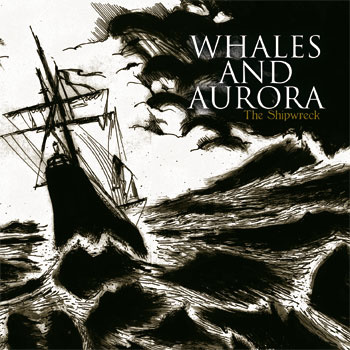
Album Review: Whales And Aurora - The Shipwreck
Lately, there’s been an awful lot of both creaking ocean-themed
concepts and atmospheric hardcore albums knocking about and this little
beauty hammers both of those increasingly prevalent events together.
These points might lead one to believe that Whales And Aurora are fans
of emotionally visceral bands like Devil Sold His Soul or Amia Venera
Landscape but having checked out their list of influences it appears
they are more likely to listen to blissed-out rumblers like Lento,
Mastodon and Russian Circles. Ignoring the incendiary wailing, the
Italians’ The Shipwreck certainly lives up to that
premise with the band cutting no corners and sinking their teeth in for
long, rotational runs to strengthen their musical structures.
Maximum volume and total immersion is required to fully appreciate the band’s efforts here, although blissful sonic drifting is made difficult and, suprisingly, the culprit isn’t Alberto Brunello’s vocal. Andrea Segnini Campesato’s snare mic has been wound up a tad too loud (trust me, you won’t miss its intermittent, aggressive “pop” sound). Instantly recognisable when it’s pounding upon the creaking bones of “Achieving The Unavoidable”, it happily sits deeper in the mix when the swathes of bottom-end cut in through the rougher sections of “Recounting Words”.
The tracks tend to rely on repeating chords which ride over peaks and through troughs, true forces of nature, but every now and then the more experimental edge of the band rises to the fore. It can be found attacking us though the monotonously crashing chord strikes of “The Aground Hard Ship” and sending our minds spiralling with the mesmerically chiming, twinkling strings of the glorious “Abandoned Among Echoes” and the somewhat clunkier “Awakened By The Aurora”.
The combined and varied musical backgrounds of the band has led to an interesting mixture of pleasure and pain; never quite tearing you apart they manage to crush and soothe in equal measure. There’s a depressive quality that settles over the listener like a cowl (the blackened gloom of “Floating On Calm Waters” is the maritime equivalent of a death march), yet the tanker-sized riffs that power the beast are from an entirely different place. The Shipwreck may not ultimately prove to be their greatest achievement, but Whales And Aurora’s waves of attack are something that just have to be experienced to be believed.
Also online (with score and links) @ Ave Noctum = http://www.avenoctum.com/2012/10/whales-aurora-the-shipwreck-slow-burn-records/
Maximum volume and total immersion is required to fully appreciate the band’s efforts here, although blissful sonic drifting is made difficult and, suprisingly, the culprit isn’t Alberto Brunello’s vocal. Andrea Segnini Campesato’s snare mic has been wound up a tad too loud (trust me, you won’t miss its intermittent, aggressive “pop” sound). Instantly recognisable when it’s pounding upon the creaking bones of “Achieving The Unavoidable”, it happily sits deeper in the mix when the swathes of bottom-end cut in through the rougher sections of “Recounting Words”.
The tracks tend to rely on repeating chords which ride over peaks and through troughs, true forces of nature, but every now and then the more experimental edge of the band rises to the fore. It can be found attacking us though the monotonously crashing chord strikes of “The Aground Hard Ship” and sending our minds spiralling with the mesmerically chiming, twinkling strings of the glorious “Abandoned Among Echoes” and the somewhat clunkier “Awakened By The Aurora”.
The combined and varied musical backgrounds of the band has led to an interesting mixture of pleasure and pain; never quite tearing you apart they manage to crush and soothe in equal measure. There’s a depressive quality that settles over the listener like a cowl (the blackened gloom of “Floating On Calm Waters” is the maritime equivalent of a death march), yet the tanker-sized riffs that power the beast are from an entirely different place. The Shipwreck may not ultimately prove to be their greatest achievement, but Whales And Aurora’s waves of attack are something that just have to be experienced to be believed.
Also online (with score and links) @ Ave Noctum = http://www.avenoctum.com/2012/10/whales-aurora-the-shipwreck-slow-burn-records/
Friday, August 10, 2012
Album Review: Ninth Moon Black – Chronophage
Finding a moment for ourselves in this fast-paced, hectic world of
ours, amidst the madcap dash to stay ahead of the game, is often pretty
hard work. The demand upon us to constantly multi-task means that, when
we do get that hour to rest, we owe it to ourselves to embrace it.
Holding on to this thought, when we grab for a piece of music, there is
something to be said for listening to leisurely, immersive pieces; songs
that start with a riff or hook, gently rotate around it, repeating the
soul of the track until you fully appreciate it from every angle. One
band who live to create such mood music is the instrumental Oregonian
outfit Ninth Moon Black.
Their sophomore effort, available as a name your price download via Bandcamp, is an organic, cohesive album – a gently-burning candle that deserves your full attention. The six songs within show an honest, clear train of thought with the tracks often merging into one another; a steady recycling of patterns to form a universal mood. Most consist of a thick, treacle-like sludge, a coming-together of the black arts and the gnarled hands of doom, and all seem to be centred around the two saw-toothed waveforms of the admittedly lengthy 14-minute “Animus Lumino”. They are slow burns that build whilst displaying both verve and emotion.
One thing that will put many off is the restrictive amount of added padding that submerges large chunks of the recording. To maintain a warm, cohesive sound, local producer Billy Barnett (Yob, Cherry Poppin’ Daddies) and mix-master Billy Anderson (Neurosis, Sleep, Melvins) have deliberately kept the more fiery edges well and truly suppressed as the band keep it low and slow – an unpredictable spitting, crackling bonfire this is not. Conversely this means the smaller flickers of brilliance, the intricate layering and changes between movements, are hard to pick out and you do actually have to listen quite closely. Lose focus and you lose half the album. Sadly, it’s like this from the off too; from those generic opening heartbeat footsteps and the eerie psychedelic touches of “Renascentia”, and on into the resultant, understated pulses of “Via Dolarosa”. The crunchy bass/drum dual kicker in “Bestia Devorat Tempus”, like your alarm call, is the point where you’ll suddenly realise just how much you’ve missed so far. With “Numeratio” resorting to type with another dulled, unambitious, slowly-repeating chord structure, it could merely be seen as an alert to your next opportunity to nod off.
So, essentially, with the music smothered, the band, unlike the more effusive, groove-laden Russian Circles or the crisp, bright brushstrokes that Red Sparowes, Explosions In The Sky and Pelican employ, has rather neglected to demand your attention. With, what amounts to a 6-minute intro and an album that feels almost like a jam that craves the full-stop marks that lyrics so often provide, this could well be an album that ends up being played in the background whilst you flit between jobs. Having devoted so many hours to this opus, determinedly hitting the replay button, I decided that it was actually quite apt that the album should be called Chronophage, literally meaning time-eater (a term I first came across when this beast appeared a few doors down). Whether you choose to see this closing remark as a backhanded compliment or a straight-up affront may just depend on whether you prefer staring at the candle or the bonfire.
Also online @ The NewReview = http://thenewreview.net/reviews/ninth-moon-black-chronophage
Their sophomore effort, available as a name your price download via Bandcamp, is an organic, cohesive album – a gently-burning candle that deserves your full attention. The six songs within show an honest, clear train of thought with the tracks often merging into one another; a steady recycling of patterns to form a universal mood. Most consist of a thick, treacle-like sludge, a coming-together of the black arts and the gnarled hands of doom, and all seem to be centred around the two saw-toothed waveforms of the admittedly lengthy 14-minute “Animus Lumino”. They are slow burns that build whilst displaying both verve and emotion.
One thing that will put many off is the restrictive amount of added padding that submerges large chunks of the recording. To maintain a warm, cohesive sound, local producer Billy Barnett (Yob, Cherry Poppin’ Daddies) and mix-master Billy Anderson (Neurosis, Sleep, Melvins) have deliberately kept the more fiery edges well and truly suppressed as the band keep it low and slow – an unpredictable spitting, crackling bonfire this is not. Conversely this means the smaller flickers of brilliance, the intricate layering and changes between movements, are hard to pick out and you do actually have to listen quite closely. Lose focus and you lose half the album. Sadly, it’s like this from the off too; from those generic opening heartbeat footsteps and the eerie psychedelic touches of “Renascentia”, and on into the resultant, understated pulses of “Via Dolarosa”. The crunchy bass/drum dual kicker in “Bestia Devorat Tempus”, like your alarm call, is the point where you’ll suddenly realise just how much you’ve missed so far. With “Numeratio” resorting to type with another dulled, unambitious, slowly-repeating chord structure, it could merely be seen as an alert to your next opportunity to nod off.
So, essentially, with the music smothered, the band, unlike the more effusive, groove-laden Russian Circles or the crisp, bright brushstrokes that Red Sparowes, Explosions In The Sky and Pelican employ, has rather neglected to demand your attention. With, what amounts to a 6-minute intro and an album that feels almost like a jam that craves the full-stop marks that lyrics so often provide, this could well be an album that ends up being played in the background whilst you flit between jobs. Having devoted so many hours to this opus, determinedly hitting the replay button, I decided that it was actually quite apt that the album should be called Chronophage, literally meaning time-eater (a term I first came across when this beast appeared a few doors down). Whether you choose to see this closing remark as a backhanded compliment or a straight-up affront may just depend on whether you prefer staring at the candle or the bonfire.
Also online @ The NewReview = http://thenewreview.net/reviews/ninth-moon-black-chronophage
Labels:
black,
chronophage,
circles,
doom,
instrumental,
metal,
moon,
ninth,
post-rock,
russian
Monday, May 28, 2012
Album Review: Bauda – Euphoria… Of Flesh, Men and The Great Escape
The moments when man places his own needs above those of the natural
world might be described as blots on our historical landscape. César
Marquez, a conceptual artist, master of multi-instrumentalism and the
man behind Bauda from Santiago in Chile, seems fascinated by the subject
and appears keen to sculpt his band’s music around these blots. Bauda’s
2009 debut album, Oniirica, attacked the generalized,
nightmarish and “devastated contemporary life” we have created, using
eclectic instrumentation such as flute, accordion and even didgeridoo.
For Euphoria… the general theme remains but the band has honed
in on a specific moment in time. Here, they attempt to whisk us back to
the 40s, 50s and early 60s when Chile’s Quintay Whaling Station was
active and killing up to 16 whales per day.
By aurally soaking us in the raw emotions of the place, they explore the depths and join hands with the workforce as they hunt, harpoon their targets and float the mighty beasts to the surface to be harvested; their carcasses left to rot. Naturally, the miasma of moods that they need to generate means you’d find it hard to pigeon-hole them and their music is quite happy genre-hopping about, even mid-song, so you’ll need to expect the unexpected.
From the off we are sunk beneath the surface to the “Ghosts Of Phantalassa” (a probable reference to the vast ocean of Panthalassa that once existed) where wood-splitting samples, oddly sounding like a rustling box of popcorn, tighten themselves up to form a crunched rhythm. Warbling keyboards and haunting vocals surround it to form a dreary, doom-laden kind of shoegaze that sadly ditches its talent all too early.
“Silhouettes”, the soul of the piece, portrays the whaler’s conflicted mind as first he sights the creatures and marvels at their beauty, the music pitching forth a catchy, uplifting lyrical sweep, then bails on us as thoughts turn to darker deeds. As you float through you’ll catch hints of Mastodon’s cosmic-prog interwoven with the darkly, shifting purpose of Lantlôs, the haunting cleans of Alcest and even the rimshots and palm-muted picking that is so evocative of instrumental post-rockers like Pelican and Russian Circles. There are even traits of Opeth in the acoustic guitar that marks out the wonderfully stripped-back “Crepuscular”.
Without doubt, the lack of shape or form is intentional, but this inevitably results in some confusing moments. You may find, like I did, that your own personal journey through the concept will delight and frustrate you in equal measure. The lack of clarity and an over-reliance on gimmicks (take the disorienting speaker-to-speaker shifting that lurks in “Acension”) over structure means the project feels all too flabby.
Despite their determination to give you the running-time to sink into their moods, they have a tendency to repeat the dullest of riffs and chord cycles which eventually result in the tracks overstaying their welcome. Some ham-fisted attempts to counteract this can be found as they opt for cringing key changes or sharp drops in pace; moments where spiked aggression suddenly morphs into twinkling dreampop. All these are vague attempts to break the blandness, but often result in confusion and a total abandonment of atmosphere. However, there are moments where it all clicks into place, demanding repeated plays. Moments like the sublimely chaotic, endorphin-loaded headrush of “Humanimals” climax, the murky trickery that lurks in “Oceania” or the uplifting wash of “The Great Escape”.
If you have the time and the patience, Bauda have the tools to shift your perceptions of what you thought possible. They refuse to choose the option to sit and fester, instead choosing to determinedly hunt down the sublime, minding not when they harpoon the ridiculous. My dull brain may struggle to keep up with all this motion in the ocean, but Bauda should still be roundly applauded for their efforts.
Also online @ Ave Noctum = http://www.avenoctum.com/2012/05/bauda-euphoria-of-flesh-men-and-the-great-escape-a-sad-sadness-song/
By aurally soaking us in the raw emotions of the place, they explore the depths and join hands with the workforce as they hunt, harpoon their targets and float the mighty beasts to the surface to be harvested; their carcasses left to rot. Naturally, the miasma of moods that they need to generate means you’d find it hard to pigeon-hole them and their music is quite happy genre-hopping about, even mid-song, so you’ll need to expect the unexpected.
From the off we are sunk beneath the surface to the “Ghosts Of Phantalassa” (a probable reference to the vast ocean of Panthalassa that once existed) where wood-splitting samples, oddly sounding like a rustling box of popcorn, tighten themselves up to form a crunched rhythm. Warbling keyboards and haunting vocals surround it to form a dreary, doom-laden kind of shoegaze that sadly ditches its talent all too early.
“Silhouettes”, the soul of the piece, portrays the whaler’s conflicted mind as first he sights the creatures and marvels at their beauty, the music pitching forth a catchy, uplifting lyrical sweep, then bails on us as thoughts turn to darker deeds. As you float through you’ll catch hints of Mastodon’s cosmic-prog interwoven with the darkly, shifting purpose of Lantlôs, the haunting cleans of Alcest and even the rimshots and palm-muted picking that is so evocative of instrumental post-rockers like Pelican and Russian Circles. There are even traits of Opeth in the acoustic guitar that marks out the wonderfully stripped-back “Crepuscular”.
Without doubt, the lack of shape or form is intentional, but this inevitably results in some confusing moments. You may find, like I did, that your own personal journey through the concept will delight and frustrate you in equal measure. The lack of clarity and an over-reliance on gimmicks (take the disorienting speaker-to-speaker shifting that lurks in “Acension”) over structure means the project feels all too flabby.
Despite their determination to give you the running-time to sink into their moods, they have a tendency to repeat the dullest of riffs and chord cycles which eventually result in the tracks overstaying their welcome. Some ham-fisted attempts to counteract this can be found as they opt for cringing key changes or sharp drops in pace; moments where spiked aggression suddenly morphs into twinkling dreampop. All these are vague attempts to break the blandness, but often result in confusion and a total abandonment of atmosphere. However, there are moments where it all clicks into place, demanding repeated plays. Moments like the sublimely chaotic, endorphin-loaded headrush of “Humanimals” climax, the murky trickery that lurks in “Oceania” or the uplifting wash of “The Great Escape”.
If you have the time and the patience, Bauda have the tools to shift your perceptions of what you thought possible. They refuse to choose the option to sit and fester, instead choosing to determinedly hunt down the sublime, minding not when they harpoon the ridiculous. My dull brain may struggle to keep up with all this motion in the ocean, but Bauda should still be roundly applauded for their efforts.
Also online @ Ave Noctum = http://www.avenoctum.com/2012/05/bauda-euphoria-of-flesh-men-and-the-great-escape-a-sad-sadness-song/
Subscribe to:
Posts (Atom)