Reviews Coming Soon

Album Review: TBA
Showing posts with label film. Show all posts

Friday, February 28, 2014

Feature: As The Palaces Burn - A Look Into Lamb of God’s Enlightening New Documentary

as the palaces burn

With the original concept of this documentary (not to be confused with the other As The Palaces Burn releases) confined to turning the cameras away from the band’s own music and their performances, Lamb Of God‘s intentions were to highlight the power of music and its influence on both the individuals and their fans – a refreshing series of viewpoints that might well have worked. Of course the arrests that followed, when they flew in to play a show in the Czech Republic on 28 June 2012, combined with the implicit level of trust that they had built up with the director, Don Argott, meant that the band took a collaborative decision to split the focus of the film’s direction.

Thus, the play opens with LOG frontman Randall D. Blythe, the self-confessed “dirtbag down by the river” (naturally, with “LOSER” emphatically emblazoned across his leather jacket) wandering along the James River in his hometown of Richmond, Virginia and musing over how his access to music has moulded him. “Music is my life. It’s what stopped me going to prison” — the irony of this statement soon comes to pass but, until that point we are invited into Lamb Of God’s practice room at the start of their album cycle. Here, whilst Randy does press, the rest of the band reflect on the rise of the band and their general disbelief at how their star just keeps on getting bigger. Here, with them all displaying natural, down-to-Earth qualities, there is a chance to emphasize the family men but also, interestingly, the individuals’ general disconnectedness, the fist-fights and Randy’s battle with alcohol abuse.


In between a few obligatory star spots for Slash, GWAR’s Oderus Ungerus and Slipknot’s Corey Taylor, we get a couple of moving fan stories on their connection to the music. Through Oscar (from Colombia) and Pratika (from India) we learn of their diverse backgrounds and the individual cultural anomalies they have, their loves and losses and, ultimately, their own relationship with music. You’d certainly expect more individual stories to be included, but there is just a general emphasis on the war-torn nature of some of the places that the band play and the united front that their fans display.

randy and fans

And then as the word “Prague” pops up on screen to replace others that have gone before it, everything changes. In an instant, the viewer must decide whether to take all consequent reportage at face-value and whether to consider the potential for the band to have used the situation to their commercial advantage, but considering the gravity of what follows, this would seem unlikely. The exploratory ramble that has gone before ends and the furious search for truth and justice begins right here, in our own minds as well as in those of the band members. We’re shown the inside of a plane and a queue of folks jostling to get off. Guitarist Mark Morton comments that, on seeing the menagerie of officials assembled on the ground, he perceived that, “there must be some fugitive on this plane.” How right he was. Of course, we all know that what follows is the band members’ arrests and a fierce line of initial questioning (guitarist Willy Adler angrily mentions that “they called [Randy] a fucking murderer”). “We waited to see what they were gonna do with Randy,” continues Mark, “and then they kept him.”

The intensity of the voices, the dark looks, the sudden silences, the manager’s heated phone conversation and the sudden appearance of a deathly serious legal team all indicate in exactly what position the band have been placed and the director pitches the tone perfectly. It slowly emerges that a fan, Daniel Nosek, present at an old Czech Lamb Of God gig, died soon after seeing them play and the implication is that Randy Blythe is being blamed for causing it. We subsequently see three contentious incidents, taken from footage filmed at the gig, that show a fan getting (or trying to get) on stage and attempts by security (and possibly Randy) to stop him. These blurry snippets of information are all there to give us a sense of the confusing circumstances and the possible validity and severity of the accusations.

When words like “murder” and phrases like “intent to cause harm” are being banded about, it isn’t so much a case of whether your eyes will be glued to the screen — it’s a case of whether you’ll ever be able to view this fucked-up world the same again. With the initial legal arguments being over bail (or the illusion of), the actual tragedy of the whole situation begins to dawn on the band. They are forced to come to terms with heartbreak and disbelief; the tragedy of losing a fan as well as having a colleague trapped in a cell in a foreign country. As Mark suggests later, “It was never us against them.” It’s an experience that Randy refers to later as like wearing a “lead helmet.”

blythe

The jump in the film here to the day of Randy’s release, 38 days later, might just represent the degree of misinformation that was reported, or simply, editorial discretion. The accompanying Q&A with Randy reveals a little about his time behind bars. The contact blackout he experienced, his fear of being singled out for punishment and getting through it by employing a daily routine of meditation, reading and writing – finding order where there was disorder. Just the imagery of the band and families waiting at the airport is enough to jolt a tear from the hardiest of souls. Willy, of course, says it all when he breaks down whilst hugging his friend — “I missed the fuck out of you… best day ever.”

With the court case hanging over them, their “comeback show” in an Iowa cornfield feels a little stilted but Randy’s delight at the faith the fans have shown in him is honest. When questioned later about the situation and whether he considered never returning for the trial, he is adamant that he couldn’t possibly do anything else. Knowing his own psychological vulnerabilities and his constant battle to stay sober, he suggests that not being able to look himself in the mirror would have resulted in an irresistible return to the bottle and inevitable self-implosion — “in my heart, it was just the right thing to do.”

Three months later and the preparation for the trial ramps up the pressure upon him and, by proxy, us viewers. Knowing he may have to explain why the fans want to launch themselves from a stage or the vagaries of slam-dancing shows just how little faith his legal team have in what the judges will know and understand. “Whatever happens, they can’t make me guilty” — it’s a sentence that pinpoints his state of mind. Then, the first day of the trial is upon us and Randy emerges sporting a haircut, fully booted and suited. Facing three judges (with one presiding) and just one prosecutor, there is immediately the sense that all is not well. Unsurprisingly, considering the event was nigh on 3 years ago, the subtitled witness statements prove to be sketchy at best. Immediately, Randy’s legal team are scrutinizing the reliability of the witnesses. There follows suggestion that Randy’s on-stage gestures were mistranslated as an invitation to “come up on stage,” and his criticism of security that night is duly reported.

What follows is the revelation that another fan’s home videos and photos from the night prove that the on-stage fan we see is not Daniel Nosek. That information would leave the judge with nothing in the way of video evidence to take into consideration, witness confusion and inconsistencies, and a clearly determined defense team having ticked all the boxes. Daniel’s uncle’s statement duly rams home the reality by admitting that Randy may not fully be to blame, but breaks hearts when he goes on to explain Daniel’s complex family situation and the mother’s severe mental anguish meaning she can no longer earn a living. No side will ever actually win this case. There will only be losers.

randy blythe defense

The final day of the trial rolls around and Randy still feels he will be found guilty on a lesser charge — possibly negligence which he suggests could get him 6 years in prison. In his final statement, a dejected and sombre Randy explains his emotions but says he is remaining objective; he is just desperate to reveal the truth. Upon hearing he has been “cleared of the charge of manslaughter” (his legal team are seen assuring him he has been “completely exonerated”) he remains stony-faced — just a shaky thumbs up that he understands is the only sign that he has understood. Predictably, we get a smack of dramatic music fading in as the judge’s verdict is fading out — without that, the moment would still be transferred to us through that single shot of Randy’s face, bursting with conflicting emotions. Back home, there are no band member celebrations — just reserved smiles and Willy’s statement, a few weeks later, that “It’s becoming a reality that we’re Lamb Of God again.” The final say goes, appropriately, to drummer Chris Adler’s insightful reflection: “Now we’ve been through this really traumatic event together, I would dare to say, until one of us dies, we’re stuck together.”

Such is the disparate nature of the original concept and the end result, it is easy to draw the conclusion that one cannot breathe next to the other. There is certainly a sense of that when you compare the diverse reactions drawn from the varied characters’ ponderous connection to the music, with the united intensity of the band’s own powerful emotions that surround the trial. There are moments of gravity in both concepts but, no matter where your starting point, one will impact more on you and on an extremely personal level, the other far less so. No flippant directorial attempt to loop us back to that original idea (which does come near the film’s end) was ever going to make this release about anything but an insatiable thirst for some insight behind this whole strange and sorry saga. On that front, this documentary comes through in spades. Its story is clear as a bell, beautifully composed and, despite the initial doubts at the potential damage that filming such a hot potato might have and the subtle hints towards showing the best side of the band, their integrity remains intact.

One thing that is made clear during the bonus material, is that we certainly won’t be seeing Lamb Of God back in the Czech Republic unless the family of Daniel Nosek specifically request it — unexpectedly, those associations and implications kicked off by this case being brought into being will last forever. Essentially, this documentary is Lamb Of God’s way of passing their “lead helmet” on to us. Watching and absorbing the events of the trial are a grave, upsetting and deeply profound experience and, on a personal level, it feels like an honour to be given such unique access to an event that has and will continue to change lives.

Also online @ Heavy Blog Is Heavy = http://www.heavyblogisheavy.com/2014/02/26/as-the-palaces-burn-a-look-into/

Monday, March 3, 2008

Film: The Bank Job

Hanging off the bones of the true story of the ‘Walkie Talkie Robbery’, The Bank Job covers the tale of a gang of petty thieves and their attempts to tunnel under a bank vault whilst a ham radio enthusiast listens in on their transceiver conversation with their trusty look-out.

Jason Statham stars and he plays to type stamping his own version of butch and cockney onto everything. Butch and cockney - that could sum the film up to be honest. I keep expecting Jack Regan or Gene Hunt to pop up and yell something about putting one’s knickers on. It’s ‘Ocean’s Eleven’ set in grimy seventies London. It’s a humourless ‘Lock, Stock and Two Smoking Barrels’ and yet it drifts between a smack in the face and a friendly punch on the shoulder; from overwhelming seriousness to smiles and joshing. It’s confused about where it belongs - a visceral true portrayal of facts or a comedy crime caper - and, consequently, refuses to flow freely.

With the sub-plot of an implicated Royal Family, a desperate Whitehall, and a horde of bent coppers the film flounders between the various criminal activities leaving you lost about exactly who the good guys are. Yet, it’s not all bad. It’s well-acted with Daniel Mays, as gang-member Dave, and David Suchet, playing an extremely vindictive crime lord, both shining. Also director Roger Donaldson manages to create a good deal of tension by utilising a combination of clever angles, bleak settings and rapid cuts. Throw in an understated yet insistently pulsating soundtrack and a script full of deception and there are many reasons to keep watching. Ultimately that big pay-off arrives but there is quite a long sequence of frustration to endure. Watch it for the true story element and not just because it’s another heist movie.

© Johnskibeat

Commissioned by Local Secrets online magazine...

Friday, February 29, 2008

Film: Be Kind Rewind

A large percentage of cinema-goers who will see the Be Kind Rewind trailer before deciding to see the film will certainly be caught off-guard by this. What initially appears to be another plain old slapstick comedy turns into something far more interesting. Good old Michel Gondry, he’ll always keep you on your toes.

It’s all fairly straightforward. Mr. Fletcher (Danny Glover) owns a run-down video store and he leaves his loyal employee, Mike (Mos Def), in charge while he takes a few days off to work out how to fend off the threat of imminent closure. Mike’s error-prone friend, Jerry (Jack Black), subsequently manages to wipe every single videotape clean by magnetising himself whilst attempting to sabotage the local power-plant. The only way to keep the customers happy is for the hapless pair to film their own versions of the tapes with surprising results.

Sounds like a goof-a-thon, right? Well, partly. Certainly whenever Glover’s character is off-screen it’s a barrel of laughs. Mos Def and Jack Black surprisingly make quite the comic pairing. Cue the hilarity as a sudden horror-movie soundtrack plays with the duo pulling agonized faces as they realise the tapes are all blank. Throw in the neat effect of the whole cinema screen warping and fizzing with static as Black approaches and you’ve got comedy gold. Melonie Diaz’s character adds another dimension as they all set about shooting zero-budget remakes of ‘Ghostbusters’, ‘Rush Hour 2’, ‘King Kong’ - whatever the customers ask for. Director Michel Gondry refused to allow his stars to view the original films before they shot them which might explain why the subsequent mayhem has a particularly random flavour to it. Black, for instance, had never seen ‘Driving Miss Daisy’ and his dismal portrayal of the lead character leads to some clever on-the-spot scripting or possibly witty improvisation by his fellow actors. Each of their quick-fix films features ingenious ways of pulling off those famous scenes - the use of a cement-mixer to recreate the ‘Men In Black’ tunnel car-chase is a fine example of what’s on offer.

On Mr. Fletcher’s return, however, there’s a sudden lull in events. Glover’s character is the father figure embodying the gloom of the financial state of the store. It doesn’t appear to be intentional but his re-introduction effectively instantly changes the impetus of the film from comedy to sentimentality. Despite the anti-climactic feel to subsequent events it brings with it a change of pace, a chance to re-evaluate and inject warmth into the film. Suddenly the importance of the town, its heritage and its people are of higher importance and with the main characters established it gives us a different picture entirely.

In the final analysis there are parts of the plotline that remain undeveloped and there’s a patchy understanding of realism but then, like Gondry’s past films, those things have never been high priority. You could watch this bitter-sweet, and surprisingly quirky, film for many reasons but I feel, perversely, you may end up disappointed by the very reason for which you went.

This website is well worth a peek at. From here you can view trailers of all the film remakes the cast did: http://www.bekindmovie.com/


© Johnskibeat

Commissioned by Local Secrets online magazine...

Wednesday, November 21, 2007

Film: The Darjeeling Limited

Hotel Chevalier, the short film before the main event, was first shown at the Venice Film Festival and has since been gracing the small screens of digital music players far and wide. It’s a pretentious and unnecessary pre-cursor that introduces the character of Jack Whitman (Jason Schwartzman) as he woos his ex-girlfriend (Natalie Portman) into bed. One can’t help but suspect that Schwartzman’s co-writing credits included this whole scene for his own good.

Thirteen minutes of posturing and pouting and thankfully the main show begins. It’s an intriguing tale of three Whitman brothers, who’ve drifted apart since the death of their father, and their journey of spiritual enlightenment to find their errant mother (Angelica Huston) through the colourful backdrop of India. Each brother has his own set of neuroses that he brings to the melting pot. Jack is quiet and often thoughtless, Peter (Adrien Brody) has many insecurities and Francis (Owen Wilson) is overwhelmingly controlling.

Cut to the bare bones, it’s basically Wes Anderson doing a buddy road movie. He’s as clever as ever in his attention to detail and the framing of his shots is excellent - often a character will be missing from the crop only for his head to fill the small remaining gap as he leans in to deliver a line. The beautiful landscapes of India have been captured in a multitude of vibrant blues, oranges and reds. The slow pace of the film suits its surroundings but it does tend to blunt the impact of certain scenes.

It’s a film that both delights visually and infuriates emotionally in equal measure. The inert and meandering script can leave one feeling rather detached from events. With actors like Bill Murray and Owen Wilson on display there is a smattering of humour, even if it is rather black humour, which lifts the oppression albeit briefly. Ultimately, The Darjeeling Limited is certainly not going to be, ahem, every one’s cup of tea.

For fans of: The Royal Tenenbaums, The Life Aquatic, Rushmore

Friday, November 9, 2007

Film: 30 Days Of Night

Adapted from the graphic novel by Steve Niles and Ben Templesmith, 30 Days Of Night whisks us to Barrow, the most northern town in Alaska. Bleak, barren and freezing, only the hardiest of souls can survive in such an environment. As the sun falls below the horizon for the last time for 30 days, the first of many brutal killings alert the townsfolk that they’re not alone.

Eben (Josh Hartnett), the town sheriff, is handed the task of protecting his own and in the middle of the mayhem he manages to get as many as possible holed up in a hidden attic from where they view a killing spree initiated by a large group of particularly brutal Nosferatu hell-bent on the town’s complete annihilation. “Their heads must be separated from their bodies. Do not turn them”, drawls head-vamp Marlow (Danny Huston).

The director, David Slade, has made a good attempt at translating the grim novel from page to screen and employs some clever camerawork in places. The overhead pan as the vampires attack their victims is particularly effective; a bird's-eye view of bright-red blood stains on pure-white snow, gun shots fired aimlessly, and dark figures fleeing and chasing; an eerie detached way of viewing the carnage. Unfortunately, he subsequently allows the continual doom and gloom to suffocate the film without respite.

There are some particularly gruesome effects and, in places, the make-up work is terrifying. Danny Huston’s is particularly effective as he’s transformed from everyman into the worst kind of walking nightmare. Barrow's isolation from the world certainly comes across well as it slowly becomes a ghost-town, resembling scenes from a Western only with snow in place of dust.

The casting of Josh Hartnett is both a blessing and a curse. He’s particularly adept at depicting the off-camera horror in his face but, in general, having a well-known actor for the lead detracts from the impact of the film. Ben Foster, bringing a particularly nasty evilness to his role as The Stranger, and Mark Boone Junior (Beau Brower) were both deserving of more screen-time.

It’s, at first, a particularly intense and effective vampire chiller, but eventually it ends up overwrought, wallowing in its own bleakness, and lacking in innovation. The final nail in the coffin is the ending which is both rushed and inconsistent. Those 30 days have passed and I still haven’t seen the light.

© Johnskibeat

If you liked/hated this review, leave a comment here.

Wednesday, November 7, 2007

Film: Death At A Funeral

The easiest way to describe this film is to imagine ‘Four Weddings & A Funeral’ without the weddings. It’s a character-driven funeral farce that draws a large proportion of it’s comedy from the determination of the English stereotype to keep a stiff-upper lip under the most extreme of circumstances.

Daniel (Matthew Macfadyen) is desperate to move into his own place with his wife, Jane (Keeley Hawes). When his father dies his mother (Jane Asher) is unable to cope and they are left to organise the funeral for a whole bunch of dysfunctional family members and friends.

With each family member we are introduced to another unwelcome character trait and, in turn, another twist to the fiendish plot emerges. Andy Nyman puts in a notable performance as a downtrodden and insecure hypochondriac who’s determined to be the centre of attention without causing offence; whilst Rupert Graves should be applauded for his serene portrayal of a painfully selfish brother for Macfadyen to bounce his character off. However, the majority of laughs are reserved for Alan Tudyk and his incredible range of facial acting skills as he brings the torment of a featherweight’s first experience with narcotics to life. “Why are my hands so… big?” he whines, so kick-starting another chorus of audience laughter.

Frank Oz directs and his consummate comic timing and pace are very much in evidence as he weaves Dean Craig’s savvy script into shape. There are moments when the humour becomes clichéd but it’s not so distracting as to diminish the impact of the film. The one thing that makes this stand out from many of this year’s comedies is the fact that it never takes itself too seriously. It’s just a clever and outstandingly witty British film, big on modesty and delightful in delivery.

© Johnskibeat
Commissioned by Local Secrets online magazine...

If you liked/hated this review, leave a comment here.

Friday, October 5, 2007

Film: Mr. Woodcock

Having watched the trailer you’d be forgiven for thinking this was simply a late addition to this summer’s generous helping of Hollywood slapstick comedy. Instead, the film surprises by serving up more of a meandering gentle whimsy with a subtly different take on growing pains.

The plot is fairly straight forward. John Farley (Seann William Scott), bullied as a pupil by his fearsomely strict gym teacher, the Mr. Woodcock (Billy Bob Thornton) of the title, is now a household name having written a book on self-help. As a consequence, his hometown wants to honour his achievements by giving him an award. Upon his return, however, he finds his mother (Susan Sarandon) is dating his old gym teacher and sets about trying to tactfully make her see the error of her ways.

With such a straightforward set-up you’d imagine things to jolly along quite nicely but unfortunately the film doesn’t seem to know what it wants to be. It is part-black comedy, part slapstick and part-love story. It’s further hampered by the limited acting range of Scott. His angry face comes across as indignation; his determined look has a vague umbrage about it; and his miserable face, I’m afraid, is pure resentment. [Note: For the full range please consult a thesaurus]. The poor chap has been typecast to death and when he’s given a lead role and asked to perform a whole host of emotions it’s beyond him and the film suffers as a result. To be fair, he is acting alongside Oscar nominees. One of whom, Billy Bob Thornton, has been given a completely one-dimensional character with the whole script being written around his robotic lack of feeling. This whole persona leaks into most scenes creating a sterile background off which Scott is expected to bounce. Unfortunately the duo just doesn’t manage to pull off any of the weak humour and, as a result, the film becomes a limp, tepid affair, short on jokes and long on filler.

The only reasons I can find to watch this movie is if you ever need to kill 90 minutes or you’ve already watched it a few days earlier and have forgotten the plot; and that would be understandable for it is instantly forgettable.

© Johnskibeat

Commissioned by Local Secrets online magazine...

Wednesday, October 3, 2007

Film: Michael Clayton

Lurking behind a somewhat uninspiring title hides the story of a law firm’s fixer who ends up with one too many irons in the fire. We already find Michael Clayton (George Clooney) an underpaid divorcee with a gambling problem and now his drug-addicted brother has left him penniless and without a safety net. Unsurprisingly unhappy with his lot, he had been seeking a way out by buying up a bar but can no longer pay off the unsecured loan on it. As it transpires, the law firm are in a generous mood as they need him more than ever due to their chief litigator, Arthur Edens (Tom Wilkinson), suffering a nervous breakdown. Edens had been assisting an agricultural company in their six-year long battle against many plaintiffs, but his discovery that the company has been knowingly selling harmful pesticides to customers causes him to flip out and begin compiling a case for the opposition.

It’s such a brilliant directorial debut from Tony Gilroy that you wonder if Sydney Pollack, being a master director of just these kinds of thrillers and incidentally playing the role of Clayton’s boss, didn’t pass on just a few tips. The opening and ending scenes are bold atmospheric shots of New York. Be it a Manhattan skyline or the back of a taxi cab. They’re mood and scene-setting, creating a sense of despair and foreboding – they flirt with pretentiousness but with the rest of the film so bleak they aren’t out of context. It’s impressive stuff.

The acting performances are quite brilliant, with Clooney as an intense, dark and sincere Clayton, and Tilda Swinton playing a beleaguered legal executive weighing up her job against her morals with a raw, ragged and emotive performance that should win both many plaudits. Wilkinson is an utterly convincing ‘Shiva, god of death’ as his character battles the inner turmoil of his sudden change of circumstance with the joy of a child and the foreboding of a crazed lunatic.

The low-key and surprisingly anodyne script is what lets the film down with several confusing and seemingly unnecessary inclusions to an otherwise simplistic storyline. The legalese is cut down to an acceptable minimum but unfortunately it also allows the gritty edge to blunt somewhat when the viewer should be caring more for it’s characters. These things plus the sudden and somewhat unspectacular ending detract from the impact of all the good earlier build-up work. It’s still a highly watchable and classy thriller but it may not be to everyone’s tastes.

© Johnskibeat

Commissioned by Local Secrets online magazine...

Thursday, September 27, 2007

Film: I Now Pronounce You Chuck And Larry

New York firefighters, Chuck and Larry, are best friends and everyday heroes. When the recently widowed Larry (Kevin James) realises that, in the event of his death, his children will be left with nothing he takes drastic action. He asks Chuck (Adam Sandler) to enter into a domestic partnership to protect his kids and save any loss of benefits. Later he discovers the legal implications and the two friends have to convince an obsessed and intrusive fraud investigator (Steve Buscemi) that they really are gay lovers.

The opening scene features Chuck and Larry saving a man from a burning building. It allows the viewers to clearly see their individual nuances and also their aggressively macho relationship. Amidst the most serious of situations there is plenty of room for laughs which promises much for the rest of the film. Unfortunately, from here it all descends into a series of ridiculously outlandish situations which rarely raise so much as a titter; some of which are actually painful to watch.

Characters are lampooned, the straightforward becomes unrealistic, strong women are undermined, all for the sake of an easy laugh. Every single homosexual stereotype you can possibly think of sits proudly at the forefront of this film’s script – yes, there is a soap-dropping scene. To go to such lengths to emphasise each plotline isn’t necessary. The viewer doesn’t need their faces rubbing in it to understand the ruse.

There are certainly several cameo performances that salvage some credibility and these are worth looking out for - Ving Rhames, playing a mysterious fellow firefighter, is one in particular who manages to wring out a few laughs – but overall there is a definite case of miscasting big names simply for big box office takings.

Somewhere buried deep beneath the Hollywood schmaltz lays a heart-warming story of how the most insecure of people can accommodate the most insane of lifestyles all in the name of friendship. It’s such a shame that all the accompanying buffoonery, leading to an overlong running time, ruins this perfectly decent premise.

© Johnskibeat

Postscript: In August 2007, the Sydney Morning Herald reported that Shana Levine, one of the producers of the 2004 Australian film, Strange Bedfellows, is considering filing a copyright-infringement suit against the Chuck and Larry producers. It appears that both films are about two firefighters who pretend to be homosexuals in order to take advantage of tax benefits for gay couples. Watch this space!

Commissioned by Local Secrets online magazine...

Monday, September 17, 2007

Film: Superbad

Following weeks of hype and rave reviews I was expecting Superbad to be something more than just a puerile teenage comedy. The 70’s kitsch opening titles, parodying the I-Pod adverts, was certainly a good starting point but everything after that left me more than just a little disappointed.

The film comes from the team that bought us ‘The 40-Year Old Virgin’ and ‘Knocked Up’ and features three nerdy sexually-frustrated high school students. Seth, Evan and Fogell, keen to impress on their peers just how cool they can be, set about procuring alcohol to impress girls. I’d love to say that the writers have a vastly more intricate script but it really is that one-dimensional.

Seth (Jonah Hill) is one of the least likeable characters with few morals and zero standards. He’s quite prepared to risk death to have sex and believes that getting girls drunk will force them to make errors of judgement allowing him and his friends into their beds. “We could be that mistake!” he exclaims. Evan (Michael Cera), despite being Seth’s best friend, displays a charming quality by trying to impart sensible advice whilst avoiding confrontation. It’s a difficult balance trying to keep his friends happy and impress his beau and he’s constantly battling all sides. Here is where the heart of the film lies but unfortunately the directors have allowed it to be bludgeoned by the others antics. King of the geeks is Fogell (Christopher Mintz-Plasse) who manages to draw the most laughs as he gets himself a fake ID and ends up taking a wild ride with two bad cops, one of whom is actor/writer Seth Rogen, who are keen to have nothing but a good time with their new buddy.

The constant Hollywood barrage of films featuring ugly men and beautiful women has never been displayed in such poor contrast as here. How we’re expected to believe the pairings is beyond me and immediately throws any credibility out of the window. Having said that, credibility was never likely to be part of this film’s blueprint, with the target audience being of such limited scope.

Superbad is mainly all about substituting profanity for jokes - believe it or not, there are 186 uses of the F-word. It’s crying out for a sequence of humour without any crude content but unfortunately the only respite we get is brief glimpses of Evan, minus Seth, trying to extricate him from difficult situations, and the idiotic cops trying to prove just how stupid they can really be. I’m afraid I have to report that, in this reviewer’s humble opinion, Superbad really is superbad.


© Johnskibeat

Commissioned by Local Secrets online magazine...

Monday, September 10, 2007

Film: 1408

Samuel L. Jackson, playing hotel manager Gerald Olin, leans conspiratorially inwards, dangles a key in the air and whispers, “It’s an evil f***ing room”. This is the film’s defining moment and a perfect summary of the horror contained within room 1408 of New York's Dolphin hotel.

Mike Enslin (John Cusack) is an honest and heartfelt writer who becomes bitter and twisted after the death of a loved one. His marriage breaks down and he finds himself travelling from hotel to hotel experiencing, and then systematically ridiculing, the supposed hauntings in each. He publishes the best myths rating them on mystery and intrigue alone never believing that any of them could be true. That is until he stumbles across the closed door of room 1408.

As we watch the lock mechanism twist painfully slowly from closed to open the viewer is thrust into a claustrophobic nightmare of visual and mental plot devices. The first few minutes spent inside the room are the most terrifying, when the possibilities are endless and the tricks are both canny and surprising. Enslin is quick to bat these first few away admiring the manager’s persistence to perpetuate the room’s myth with hidden props. When it becomes apparent that things have gone beyond reason the only options left are to find an unobstructed exit or descend into madness.

Cusack’s charisma and quirky acting style enables the evil of room 1408 to take form as it attacks his character’s tortured mind with remorseless energy, borrowing heavily from similar scenes in The Shining and Sixth Sense. The terror on his face throughout is gut-wrenching and holds everything together. Sadly, with the script being adapted from Stephen King’s all-too-short story, the film suffers from being rather drawn out with several overcomplicated threads ruining the tempo and patiently-constructed claustrophobia. These have probably been inserted either for variety, or, as the first few audience tests suggest, because of film studio interference. There is a sad air of inevitability about many of the sequences and second guessing the plot isn’t difficult. Thankfully the film only runs to 94 minutes so it doesn’t drag too much and the open-ended finale is clever, if a little confusing.

There is much to admire here despite the film’s flaws with fine acting performances, some clever computer imagery, and a simple, yet genius, plot. It sits nicely alongside many of Stephen King’s adaptations without troubling the best of them, yet certainly surpassing the more recent efforts.


© Johnskibeat

Commissioned by Local Secrets online magazine...

Friday, August 17, 2007

Film: The Bourne Ultimatum

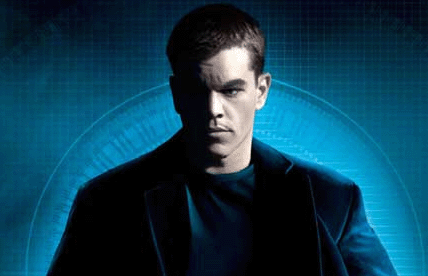
This is the cinematic equivalent of lighting a high-power repeater firework and having the director strap you to it before you can retreat to a safe distance. It’s insane and it’s the Bourne Ultimatum. The third and final instalment of a trilogy that has raised its genre’s bar to new heights, completing what has been an adrenaline-fuelled rollercoaster ride of emotion through the murky world of government splinter cells, high-tech surveillance and assassins aplenty.

The plot follows along the lines of the previous instalments. C.I.A. official, Noah Vosen (David Strathairn), is a man on a mission to destroy anyone who threatens the secret identity of an illegal government project. This includes killing Jason Bourne (Matt Damon), an assassin suffering amnesia, who needs to reveal the truth so that he may put his fractured and tormented life back together. Vosen’s colleague, Pam Landy (Joan Allen), is determined to separate right from wrong and along with C.I.A. Operative, Nicky Parsons (Julia Stiles), they provide uneasy allies for Bourne as he battles an organisation that wields more power than ever before.

This truly is a brilliant film but it’s been built upon decidedly shaky foundations. By this I mean the director, Paul Greengrass, has taken the scattergun approach to film-making and employed the documentary, fly-on-the-wall-style of camerawork throughout, with fidgety shots and rapid-fire cuts. In the quieter moments it’s nothing but distracting, whereas during the action sequences, despite sacrificing information left, right and centre, it’s stunning. We’re in the head of Jason Bourne now and this means when he steps into a scene, we are the ones scanning the area for the nearest way out. We’re the ones seeking out a weapon in case of attack. We’re the ones with sweaty palms.

Here’s just the briefest of examples. Quick-pan left to an out-of focus uphill shot of an empty alley; spin right to shaking image of a distant street; zoom and tighten frame as two policemen career round the corner at the foot of the hill; zoom out, drift up and zoom in to juddering close-up of an open window above street level; pull out to over-the-shoulder shot of a house number, then a series of flashed images: a frame, a door, an exit.

Combine all this with John Powell’s relentless musical score across the most action-packed car-chase or fist-fight scenes, or the simplest coffee-shop conversation and the tension is ramped up to unbearable levels creating a decidedly uncomfortable viewing experience.

Be it lying low in a crowded London train station, dashing across the rooftops of Tangiers, or tearing through New York City in a police car, Jason Bourne makes a fascinating travelling companion and Matt Damon has laid his character’s tortured soul bare for us. This time he’s darker, colder and more ruthless in everything he does. Julia Stiles’ deliberately restrained performance amongst the dizzying action is perfect, and David Strathairn has never been more vitriolic and revels in his role of bad guy.

The Bourne Ultimatum should come with a health warning. I had to peel myself off my seat at the end and it was a relief to get back to the mundane. Something simple like picking out the lumps of seat cover that had somehow got rammed beneath my fingernails.

© Johnskibeat

As Featured On Ezine Articles

Commissioned by Local Secrets online magazine...

Tuesday, August 7, 2007

Film: Evan Almighty

The lights dim and it’s all aboard for this crazy 21st century Noah’s ark saga as we join Steve Carell, currently Hollywood’s favourite comedy son, reprising his role from 2003’s hugely successful Bruce Almighty. He plays Evan Baxter, TV reporter turned Congressman who is visited by God (Morgan Freeman) and instructed to build an ark causing upheaval to his blossoming career and family life.

It’s quickly apparent that the storyline is scattergun at best and ludicrous at worst. Imagine The Santa Clause without Christmas. Carell, who shone so brightly playing the goofball in Anchorman and Little Miss Sunshine, finds his light vastly dimmed when put in the role of responsible parent and politician. His character’s decline into apparent madness is laboured and, at times, ineffective. Worst is the film’s tendency to veer from the simple to the overcomplicated in consecutive scenes making it pretty tough to digest.

In contrast, there’s the computer wizardry on display. Reportedly pushing $200 million, it’s the most expensive comedy ever made. This statistic alone is mind-blowing. To spend so much money perfecting the look of the film is criminal when you consider just how poorly scripted it is. As the film progresses, we’re subjected to long sequences of turgid dialogue followed by a visual feast of computer-generated animal mayhem, all ending with a glorious poster-perfect money shot. It’s a great series of images but that’s really all it is and this may explain why the trailer appealed so much.

Despite all these negative points, the film still has its moments – Morgan Freeman has his mischievous God down pat now - and at the end the smile on my face told the real story. In particular, keep an eye out for the nod to Hitchcock’s The Birds and the hilarious dancing cast as the credits roll.

Evan Almighty is a wholesome family film, heart-warming, and with a strong message promoting family values and the importance of environmental concern. Considering the younger audience to which it is quite clearly aimed it seems strange that they didn’t push harder for a Universal certificate considering how close they came.

© Johnskibeat

Commissioned by Local Secrets online magazine...

Wednesday, August 1, 2007

Film: Transformers

Cambridge’s Local Secrets review begins with “The first 32 years passed without incident. Then I saw Transformers in 2007 and my life was changed forever”. The Times had a slightly different viewpoint and eloquently described it as the equivalent of director, Michael Bay, “beating his chest and waving his penis at us for a couple of hours”. The truth lies somewhere in between.

This movie is an absolute orgy of stunning computer effects. It’s simply jaw-dropping stuff. It succeeds in this where the latest Star Wars efforts failed simply by displaying just what is possible when you unite the best visual director in the world today with a lot of money and a genre like science fiction.

For an hour I gaped in awe as it built from everyday human events into a national crisis with an unseen and unknown enemy, attacking with a force and intensity never witnessed before on Earth. Everything was buzzing along nicely as the evil Decepticons asserted their dominance and then the holier-than-thou Autobots landed and Optimus Prime, their leader, opened his big fat gob. In an instant, I realised the movie I was watching wasn’t going to finish the good work it had started. The payback never came.

It’s actually quite easy to see why it came to this. Michael Bay simply tried too hard to tick all the boxes. You cannot create a movie based on a set of kiddy toys who come packaged with their own simplistic and incomplete back story and hope to ever produce something that pleases the children that played with those toys, the geeks who have latched on to the character cult status, and the movie buffs.

The basic premise of good robots versus evil robots is completely bang-on the money. Where it fails is the human element. By making the robot effects so awesome, Bay has overcompensated by making the human reaction try to equal it. You simply can’t do it without losing the credibility. The stunts are obscenely complex, the vehicles are spotlessly shiny and the sets just get bigger and less realistic.

The result is the movie equivalent of a tag-team wrestling contest between Terminator 2 and The Rock versus 2 Fast 2 Furious and Matrix Revolutions. One minute it’s the best disaster movie ever, the next it’s a lad’s wet dream. Go and see this by all means, but when you turn off you mobile, remember to do the same with your brain.

© Johnskibeat

As Featured On Ezine Articles

Friday, June 29, 2007

Film: Shrek The Third

This third instalment of the saga of the lovable ogre begins with the newly-weds, Shrek (Mike Myers) and Fiona (Cameron Diaz), filling-in for the ailing King of Far, Far Away (John Cleese). As he weakens further, the King asks Shrek to take his place or find Arthur (Justin Timberlake) the only remaining heir to the throne. Unwilling to relinquish his dream of returning to his swamp with his bride, Shrek heads off with faithful sidekicks Donkey (Eddie Murphy) and Puss (Antonio Banderas), leaving Fiona and her royal friends to guard the castle.

Meanwhile, Prince Charming (Rupert Everett), having been humiliated in Shrek 2, is determined to make his own "happily ever after" and recruits a band of ne'er-do-wells to storm the castle so enabling him to claim the throne for himself.

So begins the kind of adventure that we are now used to seeing in the Shrek films. This one is easily as good as the others with its usual smattering of toilet humour and rapid action sequences, all displayed in glorious animated form. In fact the computer-wizardry is even better than before. Lush forests, lapping waves and even mirror-reflections are nigh-on pixel-perfect.

The audience tonight mostly comprises parents and their kids and there are very few moments that don't raise a chuckle or shriek out of one of those groups. The Gingerbread Man's "extra jelly-tot" gets the biggest laugh out of the kids and Pinocchio's "not lying" scene tickles the adults the most. Again, the humour is pitched perfectly to suit all ages.

Just when you feel the writers may have ran out of ideas they throw in yet another twist, such as when Merlin (Eric Idle) uses magic to teleport Shrek and friends back home, only to have Donkey and Puss exchange personalities with inevitable hilarity. There are moments of musical genius too - watch out for the Frog Chorus singing "Live & Let Die" and the Snow White (Amy Poehler) version of Led Zeppelin's "Immigrant Song".

The only notable criticism I have is Arthur's transformation from puny school-kid, who even the geeks bully, to brave and noble hero seems a little sudden to be believable. Despite this flaw, the character is instantly likeable, if a little slow-witted, and by the end the audience are all rooting for him. Certainly the choice of Justin Timberlake to voice the character is bang on the money and his portrayal of the sullen teen is believable enough to keep poor Shrek on his toes.

This may be the last we see of Shrek, save for the odd TV appearance (Dreamworks' are currently filming a half-hour TV special called "Shrek The Halls" which is due in early 2008), but this film has already done enough to make the smelly green giant one of the most successful animated characters of all-time.

© Johnskibeat

Commissioned by the Local Secrets online magazine...